
Introduction
Most companies treat hiring like an HR task.
- Post a job
- Wait for applications
- Screen resumes
- Conduct interviews
And hope the right candidate shows up.
But here’s the reality:
👉 This is not hiring. This is waiting.
High-growth companies don’t wait for talent.
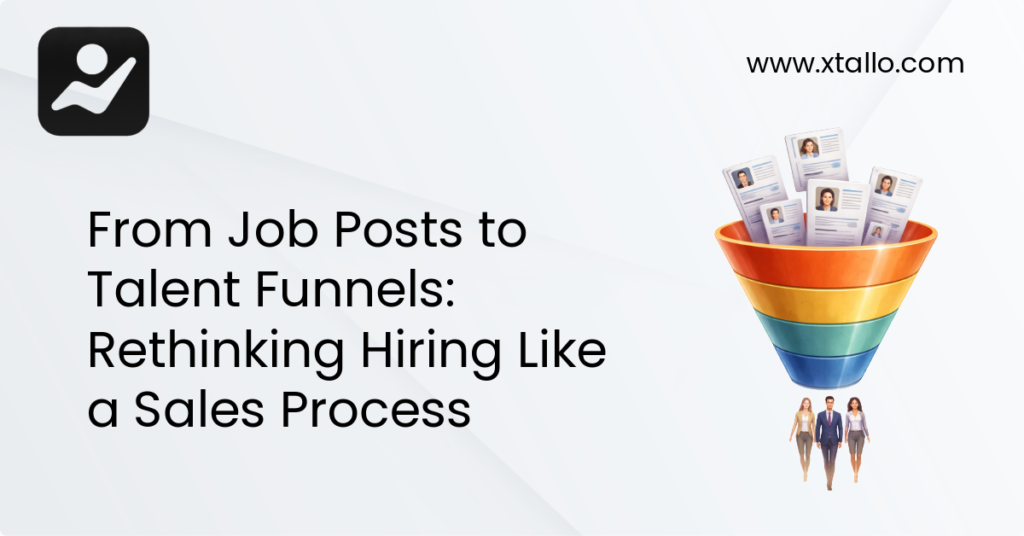
👉 They build talent funnels-just like sales funnels.
Traditional Hiring vs Talent Funnel Approach
| Factor | Traditional Hiring (Job Posts) | Talent Funnel Approach |
|---|---|---|
| Mindset | Reactive | Proactive |
| Talent Flow | Inbound only | Inbound + outbound |
| Control | Low | High |
| Speed | Slow | Fast |
| Quality | Random | Filtered |
| Scalability | Limited | High |
Why Job Posts Don’t Work Anymore
1. You Only Reach Active Job Seekers
Job posts attract:
- People actively looking
- Often average or desperate candidates
But the best talent?
👉 They’re not applying.
2. No Differentiation
Every job post looks like:
- “We’re hiring…”
- “Requirements…”
- “Responsibilities…”
👉 Nothing stands out.
3. You Lose Control
You depend on:
- Platform algorithms
- Candidate volume
- Random applications
👉 That’s not a system—it’s luck.
The Shift: Hiring = Sales
Smart companies think like this:
👉 Candidates = Leads
👉 Hiring process = Funnel
👉 Offer = Conversion
Hiring Funnel vs Sales Funnel (Side-by-Side)
| Stage | Sales Funnel | Talent Funnel |
|---|---|---|
| Awareness | Ads, outreach | Employer branding, content |
| Interest | Landing pages | Career pages, videos |
| Consideration | Demo, calls | Interviews, interactions |
| Evaluation | Objection handling | Skill validation |
| Conversion | Close deal | Hire candidate |
👉 Same logic. Different application.
What a High-Performance Talent Funnel Looks Like
1. Awareness Layer
Instead of job posts:
- Content
- Brand positioning
- Thought leadership
👉 Make talent notice you.
2. Attraction Layer
Instead of static descriptions:
- Engaging career pages
- Video-based company intro
- Clear growth story
👉 Make talent want to explore.
3. Qualification Layer
Instead of resume filtering:
- Skill-based evaluation
- Real-world tasks
- Video submissions
👉 Filter based on proof, not claims
4. Conversion Layer
Instead of generic offers:
- Clear role clarity
- Growth path
- Strong positioning
👉 Close like sales.
Job Posting vs Talent Funnel (Deep Comparison)
| Element | Job Posting Model | Talent Funnel Model |
|---|---|---|
| Candidate Source | Passive inbound | Active + passive |
| Evaluation | Resume-heavy | Skill & proof-based |
| Engagement | Low | High |
| Employer Brand | Weak | Strong |
| Predictability | Low | High |
| Conversion Rate | Low | Optimized |
Why This Model Wins
Because:
👉 Talent behaves like customers
They:
- Compare options
- Evaluate trust
- Look for growth
- Need convincing
👉 If you don’t “sell” your company, you lose them.
The Biggest Mistake Companies Make
They optimize:
❌ Job descriptions
Instead of:
✅ Talent acquisition systems
Where Xtallo Fits Perfectly
Xtallo is built for this exact shift.
Instead of:
❌ Random applications
You get:
✅ Pre-qualified talent pipeline
✅ Video-first profiles (instant evaluation)
✅ Tier-based filtering (Top 1%, 3%, 10%)
Without vs With Talent Funnel
| Scenario | Without Funnel | With Funnel |
|---|---|---|
| Hiring Speed | Slow | Fast |
| Candidate Quality | Inconsistent | High |
| Process Control | Low | High |
| Team Strength | Random | Strategic |
| Growth Impact | Limited | Accelerated |
Real-World Example (Simple)
Company A (Traditional):
- Posts job
- Gets 100 resumes
- Shortlists randomly
- Hires average candidate
Company B (Funnel-Based):
- Builds talent pipeline
- Attracts top candidates
- Evaluates via proof
- Hires top-tier talent
👉 Over time:
Company B wins—every time.
The Future of Hiring
Hiring is moving from:
- Posting → Attracting
- Screening → Filtering
- Guessing → Proving
And most importantly:
👉 From HR → Revenue function
Final Thought
If your hiring process looks like this:
👉 Post → Wait → Hope
You’re already behind.
The companies winning today:
👉 Build systems
👉 Build pipelines
👉 Build funnels
Because:
👉 You don’t hire great talent by chance
👉 You hire them by design