
Introduction
Most companies treat talent like a list.
- Same resumes
- Same filters
- Same hiring process
But high-growth companies don’t think like that.
They think in tiers.
Because the truth is simple:
👉 Not all talent is equal—and treating it equally destroys performance.
The difference between:
- An average hire
- A top 1% hire
…can be 10x in output, impact, and revenue.
What Is a Tier-Based Talent System?
A tier-based system categorizes candidates based on:
- Skill level
- Performance proof
- Thinking ability
- Execution consistency
Instead of:
❌ “All candidates are equal”
You define:
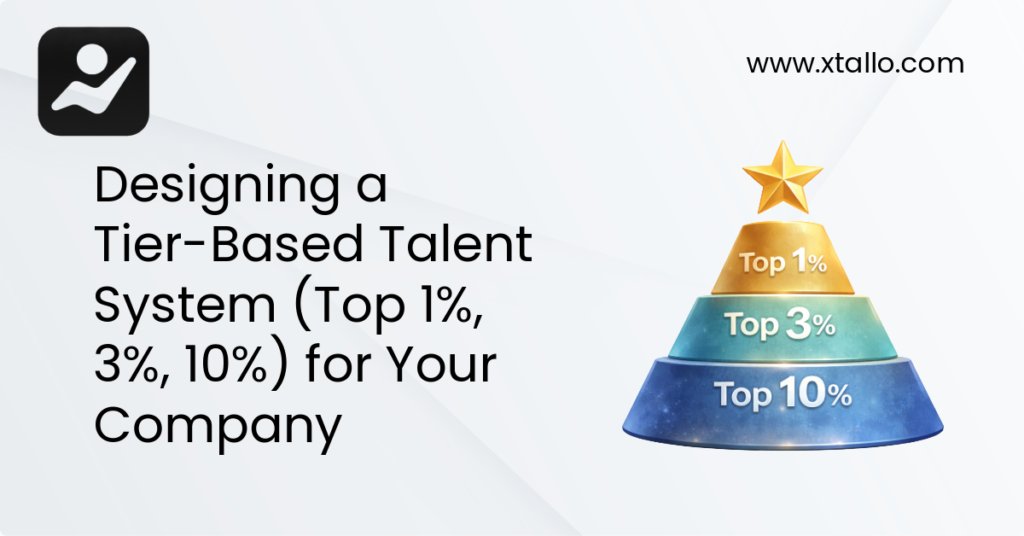
✅ Top 1% → Elite performers
✅ Top 3% → High-impact talent
✅ Top 10% → Strong, reliable talent
Traditional Hiring vs Tier-Based Hiring
| Factor | Traditional Hiring | Tier-Based Talent System |
|---|---|---|
| Candidate View | Flat list | Structured tiers |
| Decision Making | Resume-based | Performance-based |
| Talent Quality | Mixed | Clearly segmented |
| Hiring Confidence | Low | High |
| Outcome | Inconsistent | Predictable |
Why Tier-Based Hiring Changes Everything
1. It Creates Clarity
Instead of guessing:
👉 You know exactly who your best candidates are
2. It Aligns Talent With Business Needs
| Business Need | Ideal Talent Tier |
|---|---|
| Critical roles (sales leaders, strategists) | Top 1% |
| Growth roles | Top 3% |
| Execution roles | Top 10% |
👉 You stop overpaying average talent
👉 You stop under-hiring for critical roles
3. It Improves Hiring Speed
Instead of:
- Screening hundreds of candidates
You:
- Focus only on pre-qualified tiers
Tier Breakdown (Detailed View)
| Tier | Characteristics | Role Fit | Impact Level |
|---|---|---|---|
| Top 1% | Elite thinking, proven results, high ownership | Leadership, critical roles | Game-changing |
| Top 3% | Strong skills, consistent performance | Growth roles | High impact |
| Top 10% | Reliable, good execution | Support & execution roles | Stable |
The Problem: Most Companies Can’t Identify Tiers
Here’s where things break.
Companies don’t have:
- Clear evaluation frameworks
- Real performance visibility
- Standardized benchmarks
👉 So everyone looks the same.
Resume-Based Hiring vs Tier Identification
| Factor | Resume-Based Hiring | Tier-Based Identification |
|---|---|---|
| Skill Visibility | Low | High |
| Differentiation | Weak | Strong |
| Decision Accuracy | Risky | Data-driven |
| Hiring Outcome | Random | Predictable |
How to Design a Tier-Based Talent System
Step 1: Define Evaluation Criteria
Don’t evaluate randomly.
Define:
- Communication
- Problem-solving
- Execution ability
- Ownership
Step 2: Introduce Proof-Based Evaluation
Stop relying on:
❌ Claims
Start using:
✅ Proof
Examples:
- Video explanations
- Real work breakdowns
- Scenario-based testing
Step 3: Assign Tier Levels
Create clear rules:
| Score Range | Tier |
|---|---|
| 90–100 | Top 1% |
| 75–89 | Top 3% |
| 60–74 | Top 10% |
Step 4: Map Talent to Roles
Don’t mix tiers randomly.
👉 Critical roles = Top 1% only
👉 Growth roles = Top 3%
👉 Execution roles = Top 10%
Without vs With Tier-Based System
| Scenario | Without Tiers | With Tiers |
|---|---|---|
| Hiring Process | Chaotic | Structured |
| Candidate Selection | Random | Filtered |
| Team Quality | Inconsistent | Balanced |
| Growth Speed | Slow | Accelerated |
| Decision Confidence | Low | High |
Why This Model Works for the Future
The hiring market is evolving:
From:
- Resume → Skill
- Experience → Proof
- Quantity → Quality
Tier-based systems fit perfectly because:
👉 They prioritize performance, not perception
Where Xtallo Becomes Powerful
Xtallo is built around this exact concept.
Instead of:
❌ Endless candidate lists
You get:
✅ Tier-based global talent pools
✅ Top 1%, Top 3%, Top 10% visibility
✅ Video-first proof of skills
Real Advantage for Companies
Companies using tier-based hiring:
- Hire faster
- Build stronger teams
- Scale predictably
Companies not using it:
- Keep guessing
- Keep rehiring
- Keep losing time
Final Thought
The biggest hiring mistake companies make is this:
👉 Treating all candidates the same.
The smartest companies do the opposite:
👉 They identify, segment, and prioritize talent.
Because:
👉 Your company doesn’t grow by hiring more people
👉 It grows by hiring the right tier of people