
Introduction
For decades, hiring has relied on static data:
- Resumes
- PDFs
- LinkedIn profiles
But here’s the problem:
👉 Static data represents the past. Hiring decisions are about the future.
That mismatch is breaking hiring systems.
Today, companies don’t need:
❌ What someone did
They need:
✅ What someone can do right now
And that’s where dynamic talent systems come in.
Static vs Dynamic Talent Systems (Core Comparison)
| Factor | Static Talent System | Dynamic Talent System |
|---|---|---|
| Data Type | Fixed (PDF, resume) | Live, continuously updated |
| Skill Visibility | Low | High |
| Trust Level | Assumption-based | Proof-based |
| Decision Speed | Slow | Fast |
| Accuracy | Inconsistent | Predictable |
| Candidate Insight | Limited | Multi-dimensional |
What Is Static Data (And Why It Fails)
Static data includes:
- Resume snapshots
- Portfolio PDFs
- Past job descriptions
The Problem:
| Limitation | Impact |
|---|---|
| Outdated quickly | Wrong hiring decisions |
| No real-time proof | Guesswork |
| No behavior visibility | Poor team fit |
| Same format for all | No differentiation |
👉 A resume written 6 months ago cannot represent current capability.
Static Data Reality Check
| Metric | Static System Performance |
|---|---|
| Hiring error rate | High (estimated 40–60%) |
| Time to evaluate | Long (days to weeks) |
| Confidence level | Low |
| Candidate differentiation | Weak |
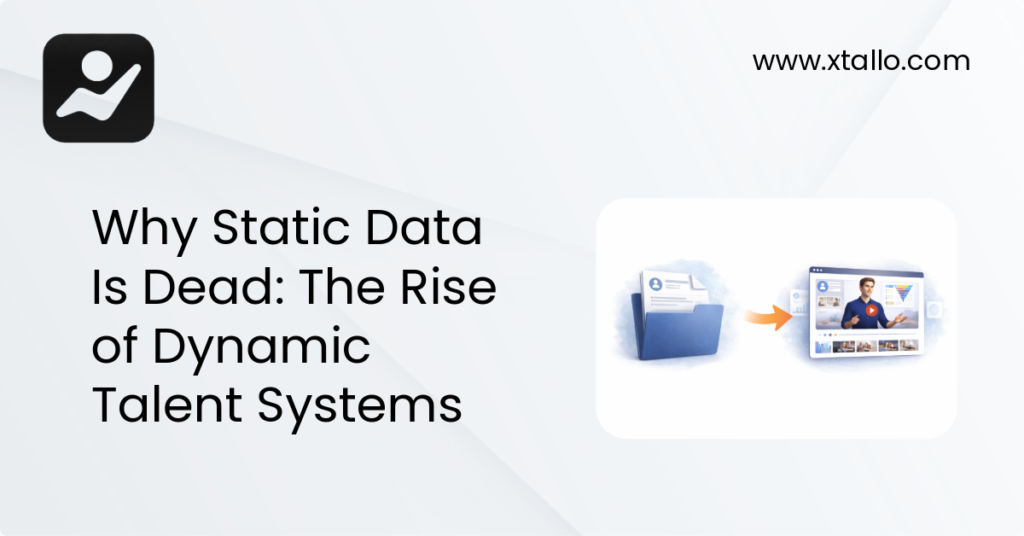
The Shift: From Snapshots to Streams
Hiring is moving from:
- Snapshot data (past)
➡️ to - Streaming data (present + evolving)
This is what defines dynamic talent systems.
What Is a Dynamic Talent System?
A system where candidate profiles include:
- Video-based communication
- Live work samples
- Ongoing performance signals
- Continuously updated proof
👉 It’s not a profile.
👉 It’s a living representation of talent.
Static Profile vs Dynamic Profile
| Factor | Static Profile | Dynamic Profile |
|---|---|---|
| Updates | Rare | Continuous |
| Skill Proof | Claimed | Demonstrated |
| Communication | Hidden | Visible |
| Performance | Assumed | Measured |
| Trust | Weak | Strong |
Why Static Data Is Becoming Obsolete
1. Speed of Work Has Changed
Skills evolve fast.
👉 What someone knew last year is irrelevant today.
2. Remote & Global Hiring
When hiring globally:
- You don’t meet candidates physically
- You can’t rely on instincts
👉 You need real-time proof
3. High Cost of Hiring Mistakes
| Impact | Cost |
|---|---|
| Wrong hire | 3–5x salary loss |
| Slow hiring | Lost opportunities |
| Poor performance | Revenue impact |
👉 Static data increases all these risks.
Decision Quality: Static vs Dynamic
| Factor | Static System | Dynamic System |
|---|---|---|
| Decision Time | Slow | Fast |
| Decision Accuracy | Low | High |
| Risk Level | High | Reduced |
| Hiring Confidence | Weak | Strong |
The Power of Real-Time Signals
Dynamic systems rely on:
- Video explanations
- Live case breakdowns
- Performance tracking
- Continuous updates
👉 You don’t “read” candidates
👉 You experience them
Where Xtallo Fits In
Xtallo is built as a dynamic talent system, not a job board.
Instead of:
❌ Static resumes
❌ Endless filtering
You get:
✅ Video-first candidate profiles
✅ Live proof of skills
✅ Tier-based talent visibility (Top 1%, etc.)
✅ Continuously evolving profiles
Traditional Hiring vs Xtallo Model
| Stage | Traditional System | Xtallo Dynamic System |
|---|---|---|
| Discovery | Job postings | Curated talent feed |
| Screening | Resume filtering | Video-based shortlisting |
| Evaluation | Interviews | Proof + performance signals |
| Decision | Gut-based | Data-driven |
The Bigger Shift: Hiring Becomes a System, Not a Process
Old model:
👉 Post → Wait → Filter → Interview
New model:
👉 Discover → Evaluate → Decide (continuously)
Before vs After Dynamic Systems
| Area | Before | After |
|---|---|---|
| Hiring Speed | Slow | Fast |
| Talent Quality | Uncertain | Clear |
| Decision Confidence | Low | High |
| Team Performance | Inconsistent | Strong |
Final Thought
Static data is comfortable.
But it’s outdated.
Dynamic systems are:
- Faster
- Smarter
- More accurate
👉 The future of hiring is not about more data
👉 It’s about better, real-time data
Because:
👉 You don’t hire who someone was
👉 You hire who they are right now