
Introduction
Traditional profiles are static.
- Resume → created once
- Portfolio → updated occasionally
- LinkedIn → edited when needed
But real talent is not static.
👉 Skills evolve
👉 Performance changes
👉 Communication improves
So why are we still using frozen profiles to make dynamic decisions?
The answer is simple:
👉 The system hasn’t evolved.
What Is a “Living Talent Profile”?
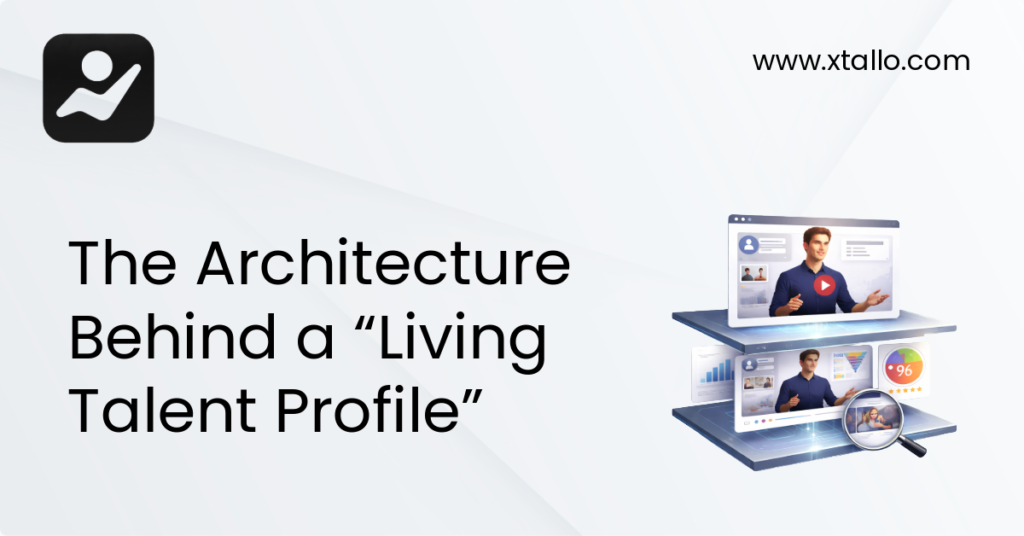
A Living Talent Profile is not a document.
It is a continuously evolving system that reflects:
- Real-time skills
- Actual work
- Communication ability
- Performance signals
👉 It’s not what you were
👉 It’s what you are right now
Static Profile vs Living Talent Profile
| Factor | Static Profile | Living Talent Profile |
|---|---|---|
| Nature | Fixed | Dynamic |
| Updates | Manual, rare | Continuous |
| Skill Visibility | Low | High |
| Communication | Hidden | Visible (video) |
| Trust Level | Assumption-based | Proof-based |
| Decision Speed | Slow | Fast |
Why Static Profiles Fail at Scale
1. They Age Fast
A resume from 6 months ago:
👉 Already outdated
2. They Hide Real Capability
You see:
- Titles
- Companies
You don’t see:
- Thinking
- Execution
- Communication
3. They Don’t Show Growth
There’s no visibility into:
- Improvement
- Learning speed
- Consistency
The Core Architecture of a Living Talent Profile
This is where things get interesting.
A Living Talent Profile is built on 3 foundational layers:
1. Identity Layer (Who You Are)
Includes:
- Basic details
- Role positioning
- Core strengths
👉 This is the only “static-like” part
2. Proof Layer (What You Can Do)
This is the most important layer.
Includes:
- Video explanations
- Work breakdowns
- Case studies
- Real outputs
👉 This replaces resumes entirely
3. Signal Layer (How You Perform Over Time)
Includes:
- Consistency
- Outcomes
- Feedback loops
- Activity
👉 This shows trajectory, not just ability
Layer Comparison (Old vs New System)
| Layer | Traditional System | Living Profile System |
|---|---|---|
| Identity | Resume basics | Structured identity |
| Proof | Portfolio (static) | Video + dynamic proof |
| Signals | Missing | Continuous performance data |
How the System Actually Works (Flow)
Step 1: Input (Talent Adds Proof)
- Video pitch
- Case breakdown
- Work samples
Step 2: Structuring (System Organizes It)
- Categorization
- Skill tagging
- Tier mapping
Step 3: Signal Generation (Performance Tracking)
- Engagement
- Feedback
- Consistency
Step 4: Output (Company View)
- Clear profile
- Instant understanding
- Faster decisions
Traditional Hiring Flow vs Living Profile Flow
| Stage | Traditional Flow | Living Profile Flow |
|---|---|---|
| Discovery | Job boards | Talent discovery feed |
| Screening | Resume filtering | Video-first filtering |
| Evaluation | Interviews | Proof-based evaluation |
| Decision | Gut feeling | Data + signals |
Why Video Is the Core Layer
Because video captures:
- Communication
- Confidence
- Thinking clarity
👉 Things that text can never show
Text vs Video vs Live Signals
| Element | Text | Video | Live Signals |
|---|---|---|---|
| Communication | Weak | Strong | Strong |
| Trust | Low | Medium-High | High |
| Real Capability | Hidden | Visible | Measurable |
| Decision Speed | Slow | Fast | Very Fast |
What Companies Gain from This Architecture
| Benefit | Impact |
|---|---|
| Faster Hiring | Reduced decision time |
| Better Talent Match | Higher performance |
| Lower Risk | Less hiring mistakes |
| Higher Trust | Proof-based decisions |
What Talent Gains from This System
| Benefit | Impact |
|---|---|
| Better Visibility | Stand out instantly |
| Fair Evaluation | Skill over background |
| Faster Opportunities | Less waiting |
| Growth Tracking | Continuous improvement |
The Bigger Shift
Hiring is moving from:
❌ Profiles →
➡️
✅ Systems
From:
- Static data
➡️ - Dynamic signals
From:
- Claims
➡️ - Proof
Where Xtallo Fits In
Xtallo is not just a platform.
It is the infrastructure for living talent profiles.
Instead of:
❌ Dead profiles
❌ Outdated resumes
You get:
✅ Real-time talent identity
✅ Video-first proof
✅ Continuous performance signals
Final Thought
The biggest mistake companies make is this:
👉 Treating talent like a file.
But talent is not a file.
👉 It’s a living system
And the companies that understand this will:
- Hire faster
- Hire better
- Build stronger teams