
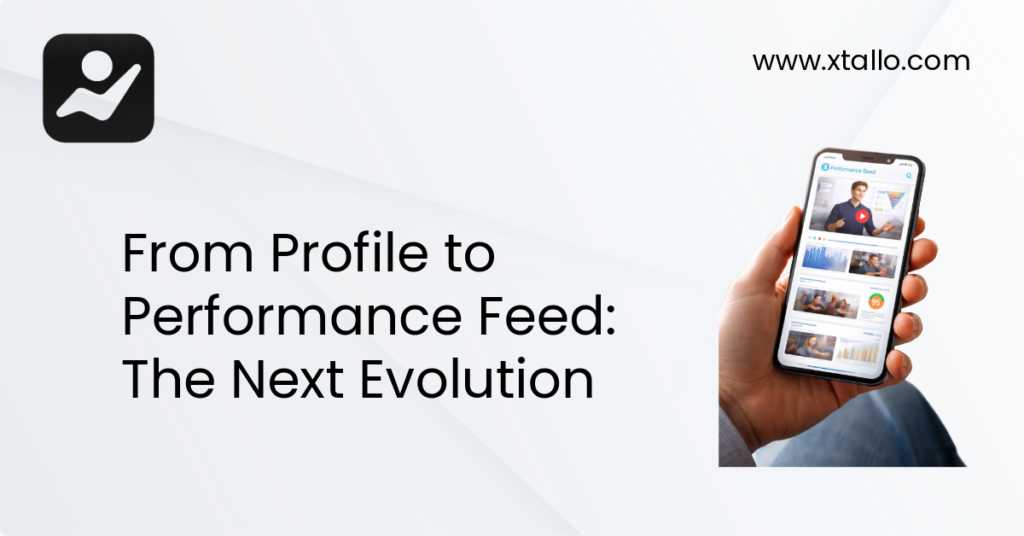
Introduction
For decades, hiring has been built on profiles.
- Static resumes
- Frozen portfolios
- Outdated information
But here’s the problem:
👉 People grow. Profiles don’t.
A resume shows what someone did months—or years—ago.
But companies don’t hire the past.
👉 They hire current performance.
That’s where the shift begins:
❌ Profile (static identity)
➡️
✅ Performance Feed (live capability)
Profile vs Performance Feed (Core Comparison)
| Factor | Traditional Profile | Performance Feed |
|---|---|---|
| Nature | Static | Dynamic (live updates) |
| Data | Past-focused | Real-time performance |
| Trust | Assumption-based | Proof-based |
| Visibility | Limited | Continuous |
| Decision Speed | Slow | Fast |
| Accuracy | Low–medium | High |
What Is a Performance Feed?
A performance feed is like:
👉 A live stream of a candidate’s capability
Instead of:
- “Here’s what I did”
It shows:
- “Here’s what I’m doing right now”
Includes:
- Video updates
- Case breakdowns
- Real outcomes
- Skill demonstrations
👉 It’s not a profile-it’s a living signal system
Why Profiles Are Failing
1. They Expire Quickly
A resume becomes outdated in:
👉 30–60 days (in fast-moving roles)
2. They Hide Real Ability
Profiles show:
- Titles
- Companies
Not:
- Thinking
- Execution
- Communication
3. They Slow Down Hiring
Recruiters need:
- Multiple interviews
- Repeated validations
👉 Because profiles don’t give confidence
Static Identity vs Live Performance
| Aspect | Static Profile | Performance Feed |
|---|---|---|
| Skill Proof | Claimed | Demonstrated |
| Communication | Hidden | Visible via video |
| Growth | Invisible | Trackable |
| Consistency | Unknown | Observable |
| Engagement | One-time | Continuous |
The Shift: From Snapshot to Stream
Old model:
📄 Snapshot (resume)
New model:
📡 Stream (performance feed)
👉 This changes everything:
- Hiring becomes faster
- Decisions become clearer
- Trust becomes measurable
Hiring Flow Transformation
| Stage | Old Hiring (Profile-Based) | New Hiring (Performance Feed) |
|---|---|---|
| Discovery | Job boards | Talent feeds |
| Screening | Resume filtering | Video + proof signals |
| Evaluation | Interviews | Real-time performance |
| Decision | Gut feeling | Evidence-based |
Real-World Example (Simple)
Candidate A (Profile-Based)
- Resume: 5 years experience
- Portfolio: 3 projects
- Interview: Good answers
👉 Decision confidence: Medium
Candidate B (Performance Feed)
- Weekly video breakdowns
- Live campaign results
- Real-time thinking visible
👉 Decision confidence: High
Impact on Hiring Metrics
| Metric | Profile-Based Hiring | Performance Feed Hiring |
|---|---|---|
| Time to Hire | 3–6 weeks | 3–7 days |
| Interview Rounds | 3–5 | 1–2 |
| Hiring Accuracy | ~60% | ~85–90% |
| Candidate Differentiation | Low | High |
| Trust Level | Weak | Strong |
Why Video Is the Core of Performance Feeds
Because video captures:
- Thinking
- Communication
- Confidence
- Clarity
👉 All in seconds
Without video:
👉 A performance feed is incomplete
Where Xtallo Comes In
Xtallo is not building profiles.
👉 It’s building performance feeds for talent
Instead of:
❌ Static resumes
You get:
✅ Continuous video-based updates
✅ Real work visibility
✅ Tier-based performance signals
What This Means for Companies
Companies using performance feeds:
- Hire faster
- Reduce risk
- Build stronger teams
Companies stuck with profiles:
- Keep guessing
- Keep interviewing
- Keep rehiring
What This Means for Talent
Top talent will:
- Showcase work continuously
- Build visibility
- Attract opportunities
Average talent will:
- Stay hidden behind resumes
Profile Economy vs Performance Economy
| System | Profile Economy | Performance Economy |
|---|---|---|
| Focus | Credentials | Capability |
| Proof | Low | High |
| Speed | Slow | Fast |
| Trust | Assumed | Earned |
| Winners | Good storytellers | Real performers |
Final Thought
The biggest shift in hiring is this:
👉 From “Tell me about yourself”
👉 To “Show me what you’re doing right now”
Profiles are static.
Performance is dynamic.
And the future belongs to:
👉 Those who show, not those who say