
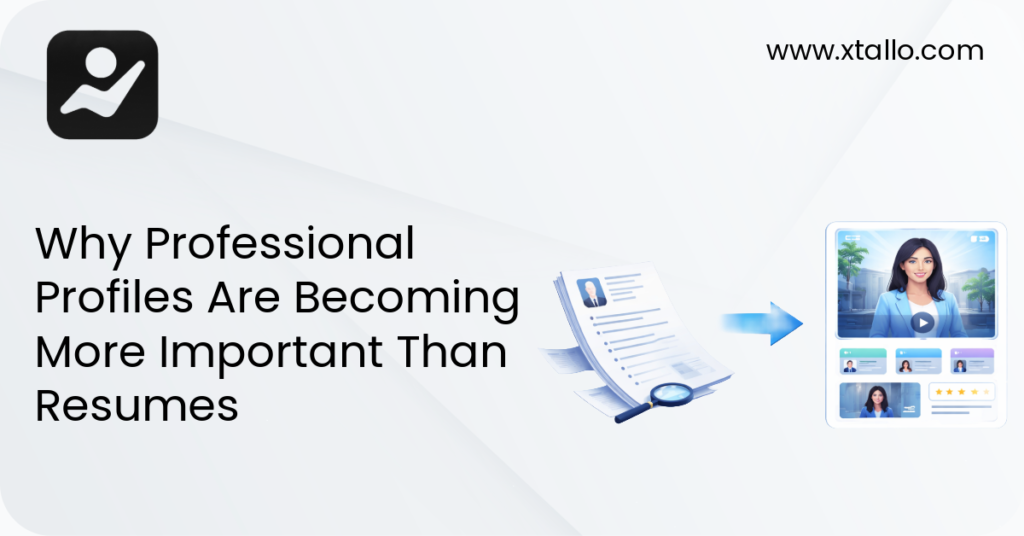
The hiring world is quietly undergoing one of the biggest shifts in decades. For years, the PDF resume was the standard way professionals presented themselves to companies. But today, that model is rapidly losing relevance.
Companies no longer want static documents. They want dynamic proof of capability-a living professional identity that shows real work, credibility, and communication ability.
That’s why professional profiles are becoming far more valuable than traditional resumes.
Platforms across the hiring ecosystem-from networking sites to portfolio platforms—are already shifting toward profile-based talent discovery, where companies evaluate professionals through a complete digital presence rather than a one-page document.
This shift benefits both sides of the market:
- Professionals gain visibility and credibility
- Companies gain faster and more accurate hiring decisions
Let’s break down exactly why this transformation is happening.
The Fundamental Problem With Traditional Resumes
Resumes were originally created in a time when hiring happened through mail, paper applications, and manual screening.
But modern hiring has completely changed.
Recruiters now deal with hundreds or thousands of applications, and static resumes fail to provide the depth companies need to evaluate candidates.
Key Limitations of Traditional Resumes
| Resume Limitation | What It Means | Impact on Companies | Impact on Candidates |
|---|---|---|---|
| Static document | Cannot evolve with achievements in real time | Recruiters see outdated information | Candidates miss chances to show recent work |
| Limited context | Bullet points rarely explain real impact | Hard to judge capability | Strong talent looks average |
| No personality | Communication style and confidence are invisible | Hiring decisions become risky | Candidates cannot differentiate themselves |
| Easily duplicated | Templates make everyone look similar | Hard to filter top talent | Profiles blend into the crowd |
| Weak proof of work | No portfolio, case studies, or demonstrations | Recruiters cannot verify claims | Candidates struggle to prove skills |
In short, resumes describe work but rarely prove it.
That gap is exactly what professional profiles solve.
What Is a Professional Profile?
A professional profile is a digital identity that showcases a person’s career, work, achievements, and expertise in a more comprehensive format.
Instead of a one-page summary, it becomes a living portfolio of credibility.
Key Components of a Modern Professional Profile
| Profile Component | Purpose | Why Companies Value It |
|---|---|---|
| Professional headline | Clearly defines expertise | Helps recruiters instantly understand positioning |
| Work experience | Detailed career journey | Shows consistency and growth |
| Skills & specialization | Highlights expertise areas | Makes candidate filtering easier |
| Portfolio / work samples | Demonstrates real capability | Provides proof instead of claims |
| Video introduction | Shows personality and communication | Helps companies evaluate cultural fit |
| Recommendations | Social proof from colleagues or clients | Builds trust quickly |
| Case studies | Demonstrates measurable impact | Shows business outcomes |
A professional profile essentially answers the question:
“What value can this person actually deliver?”
That is what companies truly want to know.
Why Companies Prefer Professional Profiles
Companies are under increasing pressure to hire faster while reducing risk. Professional profiles help them achieve both goals.
Hiring Advantages for Companies
| Hiring Challenge | Resume-Based Hiring | Profile-Based Hiring |
|---|---|---|
| Screening speed | Recruiters manually read resumes | Structured profiles allow quick filtering |
| Skill validation | Skills are claimed but not proven | Portfolios and projects demonstrate ability |
| Cultural fit evaluation | Impossible through text | Video introductions reveal communication style |
| Decision confidence | High uncertainty | More data points for evaluation |
| Talent discovery | Mostly application-based | Profiles allow proactive talent search |
This shift explains why many recruiters now prefer platforms where candidates maintain complete professional identities instead of just resumes.
Why Professional Profiles Help Candidates Stand Out
The modern job market is extremely competitive. Candidates who rely solely on resumes are often competing on the same format, the same structure, and the same bullet points.
Professional profiles break that limitation.
Candidate Advantages of Professional Profiles
| Advantage | Explanation | Career Impact |
|---|---|---|
| Personal branding | Candidates showcase expertise and positioning | Helps professionals become memorable |
| Visibility | Profiles can appear in search results | Increases inbound opportunities |
| Proof of skills | Work samples demonstrate real capability | Builds credibility |
| Communication showcase | Video introductions reveal confidence | Strong advantage in client-facing roles |
| Global opportunities | Profiles can be discovered internationally | Expands career reach |
In many cases, candidates with strong professional profiles receive job opportunities without actively applying.
The Rise of Video-First Professional Profiles
One of the biggest innovations in modern hiring is the introduction of video introductions and video portfolios within professional profiles.
Companies increasingly want to see how candidates communicate, explain ideas, and present themselves.
Why Video Is Becoming Important
| Hiring Factor | Resume | Video Profile |
|---|---|---|
| Communication skills | Not visible | Clearly visible |
| Confidence | Impossible to judge | Easily observed |
| Personality | Hidden | Naturally expressed |
| Trust | Low | Higher credibility |
| Interview readiness | Unknown | Immediately visible |
Video profiles help companies evaluate candidates before scheduling interviews, saving significant time during the hiring process.
How Hiring Platforms Are Evolving
Hiring platforms are gradually moving toward profile-driven ecosystems rather than resume-driven systems.
Platform Evolution
| Hiring Model | Characteristics | Limitations |
|---|---|---|
| Job boards | Resume submissions | High noise and low candidate quality |
| Professional networks | Profile-based identity | Still limited in skill validation |
| Portfolio platforms | Work-focused profiles | Not always integrated with hiring |
| Video-first hiring platforms | Profiles + communication + proof | Most comprehensive hiring model |
This evolution reflects a broader trend: companies want to evaluate professionals holistically, not just through documents.
Building a Strong Professional Profile
For professionals who want to stay competitive in the modern job market, building a powerful profile is becoming essential.
Elements of a High-Quality Professional Profile
| Profile Element | What to Include | Best Practice |
|---|---|---|
| Headline | Clear professional positioning | Focus on value rather than job title |
| Summary | Career story and expertise | Keep it concise and impact-driven |
| Experience | Roles, responsibilities, and achievements | Highlight measurable outcomes |
| Portfolio | Work samples, projects, campaigns | Show real results |
| Skills | Core professional competencies | Prioritize specialized skills |
| Video introduction | Short self-introduction | Explain expertise and strengths clearly |
| Testimonials | Client or colleague feedback | Strengthens credibility |
Professionals who invest time in building a complete profile significantly improve their chances of being discovered by companies.
The Future of Hiring
Hiring is moving toward a model where professionals are evaluated based on identity, credibility, and demonstrated capability.
This means resumes will gradually become supporting documents rather than the primary hiring tool.
Future Hiring Trends
| Trend | Description | Expected Impact |
|---|---|---|
| Profile-first hiring | Recruiters search profiles instead of resumes | Faster talent discovery |
| Video screening | Communication evaluated early | Reduced interview stages |
| Skill-based evaluation | Work samples replace skill claims | Higher hiring accuracy |
| AI-powered talent discovery | Platforms match candidates automatically | Improved hiring efficiency |
| Tiered talent systems | Top performers highlighted | Easier access to elite talent |
These trends clearly show that professional profiles are not just a new format-they represent the future of talent discovery.
Conclusion
The traditional resume was built for a different era of hiring-one that relied on paper applications and manual screening.
Today’s hiring environment demands more transparency, proof of work, and faster evaluation.
Professional profiles solve these challenges by providing companies with a complete view of a candidate’s capabilities, personality, and achievements.
For professionals, this shift represents an opportunity to build a stronger personal brand and stand out in competitive markets.
As hiring continues to evolve, the professionals who invest in building powerful, dynamic profiles will be the ones who attract the best opportunities.
And for companies, platforms that enable profile-driven hiring will become the most efficient way to discover high-quality talent in the years ahead.