
Introduction
Trial-based hiring sounds smart.
“Let’s test before we commit.”
On paper, it feels:
- Safe
- Practical
- Low risk
But in reality?
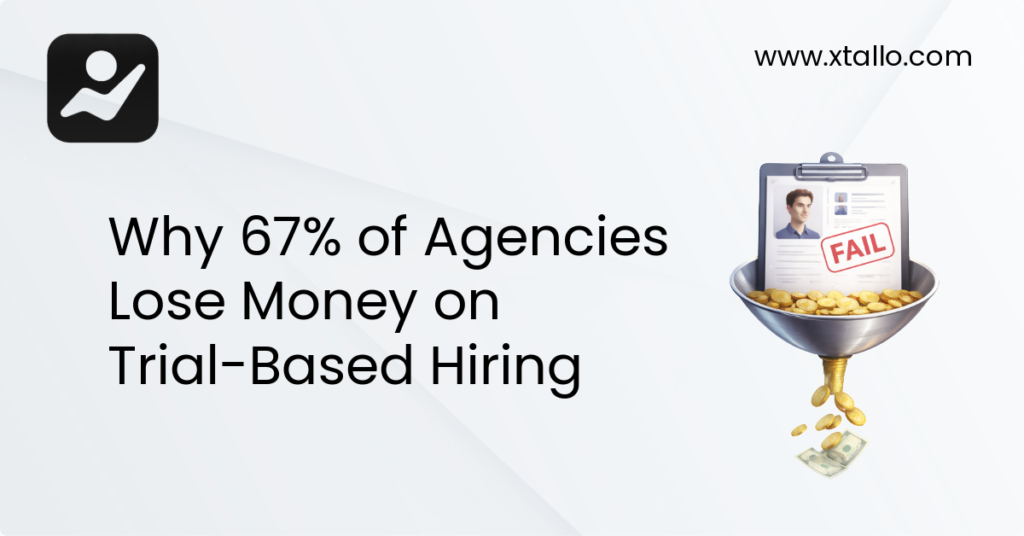
👉 67% of agencies lose money on trial-based hiring
Not because trials are bad-
👉 But because they’re poorly structured, unverified, and misleading
Trial-Based Hiring vs Proof-Based Hiring
| Factor | Trial-Based Hiring | Proof-Based Hiring |
|---|---|---|
| Evaluation Method | Short test task | Real past work + video proof |
| Time Investment | High | Low |
| Cost | Hidden + compounding | Controlled |
| Accuracy | Medium | High |
| Risk | High | Reduced |
| Decision Confidence | Low | Strong |
Where Agencies Think Trials Work
Agencies believe trials:
- Show real skills
- Reduce risk
- Help compare candidates
👉 That’s the assumption.
Where Agencies Actually Lose Money
Breakdown of Loss Areas
| Area | Impact |
|---|---|
| Time spent on multiple trials | High operational cost |
| Poor-quality trial output | Misleading evaluation |
| Repeated hiring cycles | Increased cost |
| Project delays | Client dissatisfaction |
| Internal team effort | Burnout + inefficiency |
The Core Problem: Trials Don’t Reflect Reality
1. Candidates Don’t Perform the Same in Trials
In trials:
- No real pressure
- No real ownership
- No real client context
👉 Performance ≠ actual job performance
2. Agencies Test Too Many Candidates
Typical scenario:
- 5–10 candidates
- Each given a trial
👉 Time + effort multiplies quickly
Trial Cost Example
| Activity | Time Spent |
|---|---|
| Creating trial tasks | 3–5 hours |
| Reviewing submissions | 10–15 hours |
| Feedback discussions | 5–8 hours |
| Total | 18–28 hours per role |
👉 Multiply this across hires → serious cost
3. Good Candidates Avoid Trials
Top talent thinks:
👉 “Why should I work for free?”
So agencies attract:
- Average candidates
- Desperate freelancers
👉 Not top 1% talent
4. Trials Are Easy to Fake
Candidates can:
- Reuse old work
- Take help from others
- Polish beyond real capability
👉 False positives increase
Trial-Based Hiring vs Real Performance
| Factor | Trial Performance | Real Job Performance |
|---|---|---|
| Pressure | Low | High |
| Ownership | Low | High |
| Collaboration | None | Required |
| Consistency | Unknown | Critical |
| Reliability | Uncertain | Measurable |
The Hidden Cost Nobody Talks About
Real Financial Impact
| Cost Type | Impact |
|---|---|
| Time cost | High |
| Opportunity cost | Lost clients/projects |
| Hiring delay | Revenue loss |
| Rework cost | Increased |
| Team inefficiency | High |
👉 One wrong hire can cost 2–3x the salary
Why Proof-Based Hiring Wins
Instead of testing:
👉 You evaluate real past performance
Proof-Based Hiring Advantage
| Factor | Trial-Based | Proof-Based |
|---|---|---|
| Skill Visibility | Limited | High |
| Time Investment | High | Low |
| Candidate Quality | Mixed | Filtered |
| Trust Level | Medium | High |
| Decision Speed | Slow | Fast |
What Agencies Should Do Instead
1. Evaluate Real Work
- Case studies
- Past projects
- Outcome breakdowns
2. Use Video-Based Evaluation
See:
- Thinking
- Communication
- Confidence
👉 Before hiring
3. Build Pre-Verified Talent Pools
Don’t:
👉 Start from zero every time
Instead:
👉 Maintain ready talent
Before vs After Fixing Hiring System
| Scenario | Before (Trial-Based) | After (Proof-Based) |
|---|---|---|
| Hiring Speed | Slow | Fast |
| Cost | High | Reduced |
| Risk | High | Lower |
| Talent Quality | Inconsistent | High |
| Client Satisfaction | Unstable | Improved |
Where Xtallo Fits In
Xtallo eliminates the need for blind trials.
Instead of:
❌ Testing randomly
You get:
✅ Video-first talent profiles
✅ Real proof of work
✅ Pre-verified candidates
👉 You don’t test talent
👉 You see proven talent
Final Thought
Trial-based hiring feels safe.
But in reality:
👉 It’s expensive, slow, and misleading.
The smartest agencies are shifting to:
👉 Proof-based, video-first hiring systems
Because:
👉 You don’t need to test what’s already proven.