
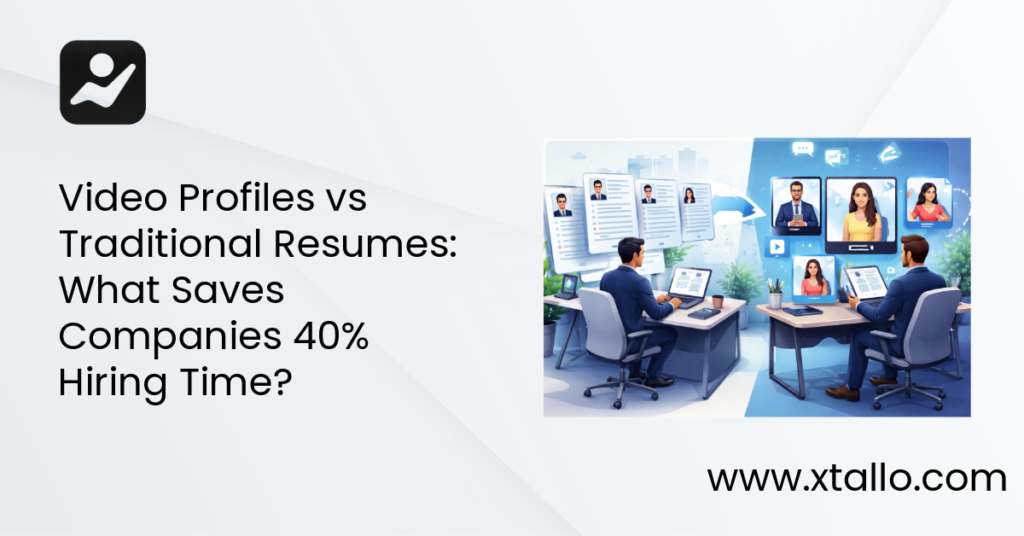
Hiring has always been a time-consuming process for companies. HR teams spend hours reviewing resumes, conducting screening calls, and filtering candidates who may or may not be the right fit.
In today’s fast-moving business environment, companies are looking for faster, smarter, and more reliable ways to evaluate talent.
This is where video profiles are starting to reshape the hiring process.
Instead of relying on static PDF resumes that only describe a candidate’s experience, companies can now evaluate communication skills, confidence, thinking ability, and personality in minutes.
The question many companies are now asking is simple:
Should we keep using traditional resumes, or is video-based hiring the better approach?
This article breaks down the comparison clearly.
Understanding the Two Hiring Formats
Before comparing them, let’s understand what each format actually represents.
| Factor | Traditional Resume | Video Profile |
|---|---|---|
| Format | Static document (PDF/Word) | Recorded video introduction |
| Information Type | Written description of skills and experience | Visual and verbal presentation of skills |
| Communication Ability | Hard to evaluate | Clearly visible |
| Personality Insight | Almost impossible | Easily observable |
| Time to Review | 3–5 minutes per resume | 30–60 seconds to evaluate basic fit |
| Authenticity | Often exaggerated | Harder to fake communication ability |
Traditional resumes were designed decades ago when hiring was slower and less competitive.
Video profiles, however, align with how people communicate and evaluate credibility today.
Why Companies Are Struggling with Resume-Based Hiring
Many HR teams report that resume screening consumes the majority of hiring time.
A typical hiring process looks like this:
| Hiring Stage | Average Time Spent | Major Problems |
|---|---|---|
| Resume screening | 6–10 hours per role | Too many irrelevant applications |
| Initial phone screening | 3–5 hours | Candidates often differ from resume claims |
| Interview scheduling | 2–4 hours | Coordination delays |
| First interview | 5–8 hours | Many candidates get rejected late |
Total estimated time for early-stage filtering alone:
16–27 hours per role
This is where companies begin to realize that most of this time could be reduced if they could evaluate candidates faster in the first stage.
How Video Profiles Change the Hiring Process
Video profiles compress multiple evaluation layers into one step.
Instead of reading resumes and then scheduling calls to evaluate communication skills, companies can immediately see how a candidate presents themselves.
| Evaluation Criteria | Resume Screening | Video Profile Screening |
|---|---|---|
| Communication skills | Not visible | Clearly visible |
| Confidence | Not measurable | Easily observed |
| Thought clarity | Hidden | Visible in responses |
| Professional presence | Unknown | Immediately visible |
| Authenticity | Hard to judge | Easier to assess |
This allows hiring managers to shortlist candidates much faster.
Hiring Speed Comparison
The biggest advantage of video profiles is time efficiency.
| Hiring Task | Traditional Resume Method | Video Profile Method |
|---|---|---|
| Review candidate | 3–5 minutes | 30–60 seconds |
| Evaluate communication | Requires interview | Immediate |
| Shortlist candidates | After multiple steps | After initial screening |
| Identify poor fits | Often late in process | Immediately |
When scaled across hundreds of applications, companies can reduce screening time by nearly 40% or more.
What Companies Actually Want to See in Candidates
Hiring managers are not just evaluating technical skills.
They want to understand how a person thinks, communicates, and represents their organization.
| Hiring Factor | Importance Level | Resume Capability | Video Profile Capability |
|---|---|---|---|
| Technical skills | High | Good | Good |
| Communication ability | Very High | Poor | Excellent |
| Personality fit | High | Very limited | Clear |
| Problem explanation ability | High | Weak | Strong |
| Professional presence | Medium | Not visible | Visible |
This is why many companies are shifting toward visual-first hiring processes.
Benefits for Companies
Video profiles are not just about convenience. They improve hiring quality as well.
| Benefit | Impact on Company |
|---|---|
| Faster candidate filtering | Reduces HR workload |
| Better communication assessment | Improves team collaboration |
| Reduced interview rounds | Saves management time |
| Improved hiring accuracy | Better cultural fit |
| Faster hiring cycles | Helps companies scale teams quickly |
For growing companies and startups, this speed advantage is especially valuable.
Benefits for Candidates
Video profiles also give professionals a chance to stand out.
Many candidates have strong abilities but struggle to express them through a simple document.
| Candidate Advantage | Why It Matters |
|---|---|
| Showcase communication skills | Especially valuable for sales, marketing, consulting |
| Build trust quickly | Employers feel more confident |
| Demonstrate personality | Important for team fit |
| Differentiate from competitors | Most candidates still rely on resumes |
A strong video introduction can often create a better first impression than a written document.
When Resumes Are Still Useful
Despite the advantages of video profiles, resumes still serve a purpose in certain contexts.
| Situation | Why Resume Still Works |
|---|---|
| Technical roles with complex experience | Detailed documentation required |
| Academic positions | Research history matters |
| Compliance-heavy industries | Documentation needed |
| Government hiring | Formal structure required |
However, many organizations are now combining both formats.
The Hybrid Hiring Model
The most effective approach today is a hybrid model.
| Stage | Tool Used |
|---|---|
| Initial candidate introduction | Video profile |
| Skills and experience review | Resume |
| Interview evaluation | Live discussion |
This model reduces unnecessary interviews and improves hiring efficiency.
Why the Future of Hiring Is Becoming Video-First
The workforce is becoming increasingly global and digital.
Companies now hire people across different countries, cultures, and time zones. In this environment, video communication has become the fastest way to evaluate professional presence and thinking ability.
Several hiring trends indicate a shift toward video-based talent evaluation.
| Trend | Impact |
|---|---|
| Remote work growth | Requires strong communication skills |
| Global hiring | Video bridges cultural understanding |
| Faster startup hiring cycles | Speed becomes essential |
| Digital-first recruitment | Platforms are evolving beyond resumes |
These changes are gradually transforming how companies discover and evaluate talent.
Final Thoughts
For decades, resumes have been the foundation of hiring. But as business moves faster and hiring becomes more competitive, companies need more efficient ways to evaluate candidates.
Video profiles provide a powerful solution by allowing companies to assess communication, personality, and confidence instantly, significantly reducing the time spent on early-stage screening.
While resumes will likely remain part of the hiring process, the future of recruitment is increasingly leaning toward visual, interactive, and authentic candidate presentations.
Companies that adopt faster evaluation methods will gain a significant advantage in attracting and securing the right talent.