
Introduction
The hiring market is going through a silent shift.
For years, companies believed:
- More candidates = better hiring
- More applications = better choices
But today, the opposite is happening.
👉 Abundance is creating confusion. Not quality.
Thousands of resumes.
Hundreds of applications.
Very few high performers.
And this is where a new model is emerging:
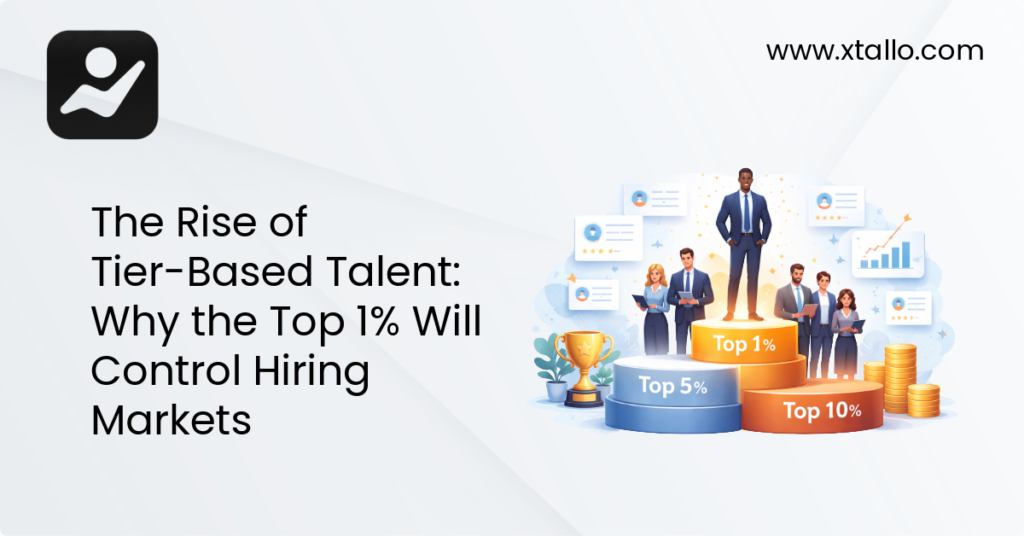
👉 Tier-Based Talent
Where:
- Top 1% gets disproportionate opportunities
- Top 3–5% dominate high-value roles
- The rest compete in saturated markets
This isn’t a trend.
This is the future of hiring economics.
What Is Tier-Based Talent?
Tier-based talent means categorizing candidates based on:
- Proven skill
- Performance ability
- Communication quality
- Real-world execution
Instead of treating everyone equally, companies now prioritize:
👉 Signal over volume
Traditional Hiring vs Tier-Based Hiring
| Factor | Traditional Hiring | Tier-Based Talent Model |
|---|---|---|
| Candidate Pool | Mass volume | Filtered elite tiers |
| Decision Basis | Resume & experience | Proven ability & performance |
| Hiring Speed | Slow | Faster (pre-qualified tiers) |
| Quality of Hire | Inconsistent | Highly predictable |
| Competition | Candidate-heavy | Talent-driven |
| Outcome | Trial & error hiring | Precision hiring |
Why the Top 1% Is Taking Over
1. Technology Has Made Talent Visible
Earlier:
- Skills were hidden behind resumes
- Companies relied on assumptions
Now:
- Video, portfolios, and proof-based platforms show real ability
👉 The best talent is no longer invisible.
2. Companies Can’t Afford Average Performers
In today’s market:
- Hiring mistakes are expensive
- Growth is competitive
- Sales cycles are tighter
👉 Companies don’t want “good” anymore.
👉 They want exceptional.
3. Top Talent Drives Disproportionate Results
One top performer can:
- Outperform 3–5 average employees
- Close high-value deals
- Build systems, not just execute tasks
👉 This shifts hiring focus from quantity → quality.
Talent Distribution Reality
| Talent Tier | % of Market | Impact Level | Demand |
|---|---|---|---|
| Top 1% | Extremely rare | Massive impact | Extremely high |
| Top 3–5% | Rare | High impact | Very high |
| Top 10% | Limited | Moderate impact | High |
| Bottom 80% | Saturated | Low differentiation | Low |
The Problem With Traditional Hiring Systems
Traditional systems:
- Treat all candidates equally
- Focus on filtering resumes
- Ignore real skill differentiation
👉 This creates:
- Noise
- Slow hiring
- Poor decisions
Resume-Based Hiring vs Tier-Based Hiring
| Factor | Resume-Based Hiring | Tier-Based Hiring |
|---|---|---|
| Visibility of Skill | Low | High |
| Candidate Differentiation | Weak | Strong |
| Hiring Accuracy | Low | High |
| Time to Hire | Long | Short |
| Confidence in Decision | Low | High |
What Defines Top 1% Talent?
Top-tier candidates are not defined by:
❌ Degrees
❌ Years of experience
❌ Company names
They are defined by:
✅ Ability to execute
✅ Clear communication
✅ Problem-solving mindset
✅ Consistent results
✅ Ownership & accountability
👉 These traits are visible, not claimed
The Shift: From Equal Opportunity to Elite Visibility
Earlier hiring mindset:
“Let’s give everyone a fair chance”
Modern hiring mindset:
“Let’s identify the best faster”
This shift is driven by:
- Time constraints
- Business pressure
- Need for predictable growth
Old Hiring Funnel vs Tier-Based Funnel
| Stage | Traditional Funnel | Tier-Based Funnel |
|---|---|---|
| Application | 1000+ resumes | Pre-filtered tiers |
| Screening | Manual & slow | Automated & structured |
| Evaluation | Interviews | Real performance proof |
| Selection | Uncertain | High confidence |
Where Xtallo Fits In This Shift
Xtallo is built around this exact idea.
Instead of:
- Endless resumes
- Unstructured profiles
Xtallo introduces:
1. Tier-Based Talent Structure
- Top 1%
- Top 3%
- Top 7%
👉 Companies directly access elite candidates
2. Video-First Proof System
- Real communication
- Real presence
- Real selling ability
👉 No guessing. Only proof.
3. Faster, Smarter Hiring
- Skip noise
- Focus on high-impact talent
- Make confident decisions
Why This Model Will Dominate by 2030
Because it aligns with reality:
- Companies want results, not resumes
- Talent wants visibility, not filtering
- Hiring needs speed + accuracy
👉 Tier-based systems solve all three.
Final Thought
The hiring market is no longer fair.
It’s becoming performance-driven.
And in this system:
👉 The Top 1% doesn’t compete
👉 They get chosen
Companies that adapt to this shift will:
- Hire faster
- Build stronger teams
- Scale predictably
Those that don’t will:
- Drown in resumes
- Make poor hiring decisions
- Fall behind