
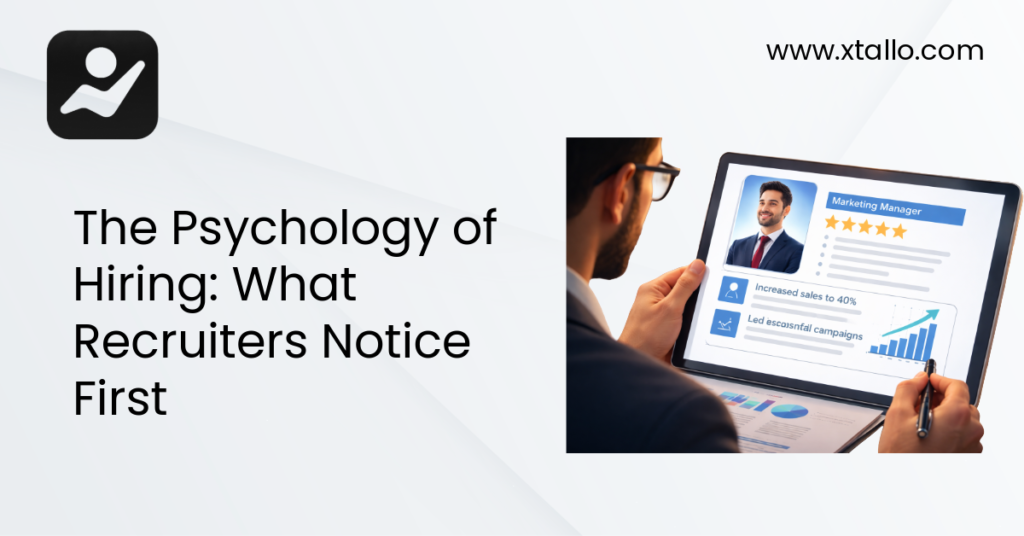
Hiring is often described as a logical process driven by skills, experience, and qualifications.
But the reality is different.
Recruiters and hiring managers make initial judgments within seconds of viewing a candidate’s profile, resume, or introduction. These early impressions strongly influence whether a candidate moves forward in the hiring process.
Understanding the psychology behind hiring decisions can help professionals position themselves better and help companies identify the right talent faster.
This article breaks down the key psychological signals recruiters notice first, and how both candidates and employers can use these insights to improve hiring outcomes.
Why Psychology Plays a Huge Role in Hiring
Recruiters review hundreds of profiles and applications every week. Because of this high volume, the brain relies on quick pattern recognition and first impressions to filter candidates efficiently.
These psychological shortcuts help hiring teams answer critical questions quickly:
- Does this candidate look credible?
- Does their profile show results?
- Can I trust this person to deliver value?
- Do they communicate clearly?
The following signals are often evaluated within the first 5–20 seconds of reviewing a candidate.
Key Psychological Signals Recruiters Notice First
| Hiring Signal | What Recruiters Notice | Why It Matters Psychologically | What Candidates Should Do |
|---|---|---|---|
| Profile Presentation | Clean, structured profile with clear information | The brain trusts organized information more than cluttered data | Use simple structure and clear headings |
| Professional Photo / Video | Facial expression, confidence, authenticity | Humans naturally judge trustworthiness through faces | Use a confident, natural image or introduction video |
| Headline or Title | The first line describing expertise | A strong headline creates immediate positioning in the recruiter’s mind | Clearly state role, specialization, and value |
| Proof of Results | Metrics, achievements, measurable outcomes | Recruiters look for evidence of impact rather than responsibilities | Add numbers, revenue impact, or growth results |
| Communication Style | Clarity, tone, and professionalism | Clear communication signals intelligence and reliability | Avoid complex jargon and write clearly |
| Experience Relevance | Alignment with the role being hired | Recruiters prioritize relevance over total years of experience | Highlight relevant projects first |
| Personal Brand | Consistency across resume, LinkedIn, portfolio | Consistency builds credibility and reduces perceived risk | Maintain a consistent professional story |
| Confidence Signals | Speaking style, presentation, tone | Confidence increases perceived leadership ability | Practice concise introductions |
| Social Proof | Recommendations, testimonials, endorsements | Humans trust opinions of others when making decisions | Showcase client feedback or team recommendations |
| Initiative Signals | Personal projects, thought leadership | Shows proactive mindset and ownership mentality | Publish ideas, projects, or insights |
The First 10 Seconds of Candidate Evaluation
Most recruiters follow a subconscious scanning pattern when reviewing candidates.
| Step | What Recruiters Look At | Purpose |
|---|---|---|
| 1 | Name & headline | Identify role positioning |
| 2 | Photo or video introduction | Assess confidence and authenticity |
| 3 | Current company / role | Understand career level |
| 4 | Key achievements | Evaluate business impact |
| 5 | Skills alignment | Determine relevance to the role |
If the candidate passes this quick scan, recruiters move to a deeper review.
Psychological Biases That Affect Hiring Decisions
Recruiters try to remain objective, but human psychology introduces natural biases.
Understanding these biases helps candidates position themselves strategically.
| Bias | Description | Hiring Impact | Candidate Strategy |
|---|---|---|---|
| Halo Effect | One strong trait influences overall perception | A great first impression can improve overall evaluation | Create a strong opening impression |
| Similarity Bias | Preference for people with similar backgrounds | Recruiters may favor familiar profiles | Highlight shared industry experiences |
| Authority Bias | People trust signals of expertise | Recognized companies or achievements increase credibility | Showcase certifications, awards, or major projects |
| Recency Bias | Recent achievements influence perception more strongly | Recruiters prioritize current work | Emphasize latest achievements |
| Confirmation Bias | Recruiters seek evidence supporting their initial impression | First impressions are powerful | Ensure early profile elements are strong |
What Recruiters Wish Candidates Understood
Many professionals focus heavily on listing responsibilities rather than demonstrating value.
The psychological difference is significant.
| Traditional Candidate Approach | Recruiter-Friendly Approach |
|---|---|
| Lists tasks and responsibilities | Highlights measurable results |
| Long paragraphs of experience | Clear, concise achievements |
| Generic career summary | Specific value proposition |
| Passive tone | Confident and outcome-focused tone |
Recruiters are not just evaluating experience—they are evaluating potential impact on the company.
How Companies Can Improve Their Hiring Psychology
Hiring psychology is not only important for candidates. Companies can also optimize their evaluation process.
| Hiring Improvement | Benefit for Companies |
|---|---|
| Structured candidate evaluation | Reduces unconscious bias |
| Video-based introductions | Allows assessment of communication skills |
| Clear success metrics for roles | Helps identify high-impact candidates |
| Standardized interview frameworks | Improves fairness and consistency |
| Talent tier systems | Helps identify top-performing professionals faster |
Companies that modernize their hiring approach often reduce hiring time and improve employee quality.
The Rise of Video-First Hiring
Traditional resumes often fail to capture personality, communication ability, and confidence.
This is why many organizations are beginning to explore video-first hiring methods, where candidates present themselves directly through short introductions or portfolio presentations.
| Hiring Method | What It Shows |
|---|---|
| Resume | Experience and qualifications |
| LinkedIn Profile | Professional network and credibility |
| Portfolio | Work samples and case studies |
| Video Introduction | Communication ability and personality |
Video profiles help recruiters understand how candidates think, communicate, and present themselves, which are critical elements for many roles.
Final Thoughts
Hiring is not purely analytical-it is deeply psychological.
Within seconds of reviewing a candidate’s profile, recruiters form impressions based on presentation, communication, credibility, and evidence of results.
Professionals who understand these signals can position themselves more effectively and stand out in competitive job markets.
At the same time, companies that adopt modern hiring methods and structured evaluation frameworks can significantly improve the quality and speed of their hiring decisions.
As hiring continues to evolve, platforms that enable clear presentation of talent, measurable achievements, and authentic communication will play a major role in connecting companies with the right professionals.