
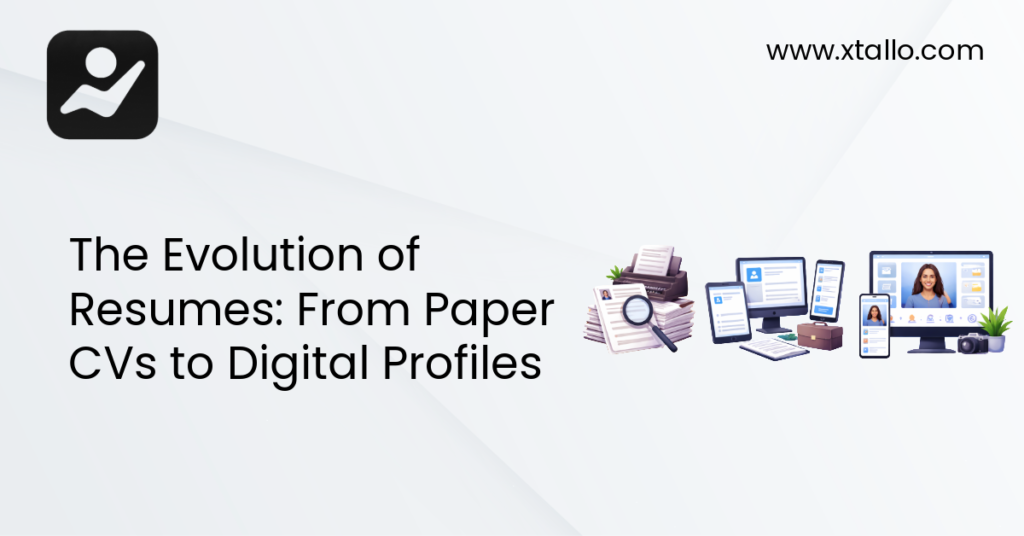
Hiring has changed dramatically over the last few decades. What once started as a simple paper resume handed to employers has now evolved into dynamic digital profiles, video introductions, and portfolio-driven talent verification.
For companies, the goal has always been the same: find the right person quickly and confidently.
For professionals, the goal is also clear: stand out among thousands of applicants.
The tools used to achieve these goals, however, have evolved significantly.
This article explores how resumes have transformed over time – from printed CVs to modern digital and video-first profiles — and why companies and professionals are now moving toward interactive talent profiles instead of static documents.
1. The Timeline of Resume Evolution
| Era | Resume Format | Key Characteristics | Hiring Process | Limitations |
|---|---|---|---|---|
| 1950–1980 | Paper CV | Typed or handwritten resumes submitted physically | Employers collected resumes manually | Slow, limited reach |
| 1990–2005 | Digital Documents | Word/PDF resumes emailed or uploaded | Job boards began emerging | Still static and hard to verify |
| 2005–2015 | Online Profiles | Platforms like LinkedIn enabled digital professional profiles | Recruiters could search talent databases | Profiles often generic |
| 2015–2023 | Portfolio & Personal Branding | Candidates added portfolios, projects, and case studies | Companies began evaluating skills beyond resumes | Still time-consuming screening |
| 2024–Future | Video & Interactive Profiles | Video introductions, proof of work, verified talent tiers | Faster screening and trust-building | Requires new hiring platforms |
This evolution shows one major shift:
Hiring is moving from static information → dynamic proof of capability.
2. Paper CV Era: The Beginning of Professional Profiles
| Feature | Details |
|---|---|
| Format | Printed document (1–3 pages) |
| Submission | Physical mail or hand delivery |
| Focus | Education, job titles, and responsibilities |
| Recruiter Process | Manually reading each resume |
| Typical Hiring Time | Weeks or months |
Challenges of Paper CVs
- Hard to distribute to multiple companies
- Difficult for employers to store and organize
- Limited opportunity for candidates to showcase personality or work
While the paper CV created the foundation of professional hiring, it lacked scalability.
3. The Digital Resume Era
With the growth of the internet, resumes moved from paper to digital files such as PDFs and Word documents.
| Feature | Details |
|---|---|
| Format | PDF or Word documents |
| Submission | Email attachments or job portals |
| Popular Tools | Microsoft Word, Resume builders |
| Recruiter Tools | Applicant Tracking Systems (ATS) |
| Typical Hiring Time | Faster than paper but still lengthy |
Benefits
- Easier distribution
- Standardized formatting
- Searchable within databases
Limitations
- Still static
- Hard to measure real capabilities
- Thousands of identical resumes overwhelm recruiters
Companies started realizing that documents alone cannot measure talent quality.
4. Online Professional Profiles
Professional networking platforms introduced digital profiles instead of simple resumes.
| Feature | Details |
|---|---|
| Format | Online profile pages |
| Platforms | LinkedIn, portfolio websites |
| Key Elements | Experience, endorsements, recommendations |
| Employer Advantage | Easier talent discovery |
| Candidate Advantage | Personal brand visibility |
Improvements
- Continuous profile updates
- Public credibility through recommendations
- Global networking opportunities
However, companies still faced one problem:
Profiles can look impressive but still lack proof of performance.
5. Portfolio-Based Talent Presentation
Professionals began showcasing real work instead of just listing skills.
| Feature | Details |
|---|---|
| Format | Portfolio websites or project galleries |
| Used by | Designers, developers, marketers, consultants |
| Content | Case studies, project results, client testimonials |
| Hiring Impact | Employers can evaluate real work |
Benefits for Companies
- See actual work samples
- Evaluate thinking and problem-solving ability
Benefits for Candidates
- Stand out among traditional applicants
- Demonstrate expertise through results
But portfolios still required manual review and interpretation.
6. The Rise of Video Profiles and Interactive Talent
The newest stage of resume evolution focuses on humanizing talent profiles.
Instead of reading a document, employers can now see, hear, and evaluate professionals instantly.
| Feature | Video-Based Profiles |
|---|---|
| Format | Short introduction videos |
| Content | Professional summary, skills, personality |
| Screening Speed | Much faster |
| Trust Factor | Higher authenticity |
| Candidate Advantage | Personality and communication skills visible |
Why Companies Prefer Video Screening
| Hiring Factor | Traditional Resume | Video Profile |
|---|---|---|
| Personality evaluation | Not possible | Immediate |
| Communication skills | Hidden | Clearly visible |
| Confidence level | Unknown | Observable |
| Trust level | Low | High |
| Screening speed | Slow | Fast |
This approach helps companies filter candidates much faster.
7. What Companies Actually Need Today
Modern organizations are facing three major hiring problems.
| Hiring Challenge | Impact on Companies |
|---|---|
| Too many applications | Recruiters overwhelmed |
| Low candidate authenticity | Hard to trust resumes |
| Slow screening process | Delays in hiring decisions |
Because of this, companies are shifting toward structured talent platforms where profiles include proof of capability.
These profiles may include:
- Video introductions
- Verified experience
- Project showcases
- Performance reviews
- Talent ranking tiers
8. What Professionals Should Do in the Modern Hiring Era
Candidates who still rely only on PDF resumes may struggle to stand out.
Professionals should focus on building multi-dimensional profiles.
| Profile Component | Purpose |
|---|---|
| Resume | Quick overview |
| Video introduction | Build trust instantly |
| Portfolio | Show real work |
| Case studies | Demonstrate results |
| Professional profile | Create credibility |
The goal is no longer just telling employers about your experience.
The goal is showing proof of your capability.
9. The Future of Resumes
The resume is not disappearing — it is evolving.
| Future Hiring Element | Role |
|---|---|
| AI-assisted candidate screening | Faster matching |
| Video-first profiles | Authentic talent presentation |
| Verified skill badges | Proof of expertise |
| Talent tier systems | Highlight top performers |
| Interactive professional profiles | Replace static CVs |
Companies will increasingly prioritize real signals of competence instead of written claims.
Conclusion
The journey from paper CVs to digital profiles reflects a broader shift in how talent is discovered and evaluated.
Resumes once served as the primary representation of professional identity. Today, however, employers expect dynamic profiles that demonstrate real skills, communication ability, and proven outcomes.
For companies, the future of hiring lies in efficient talent discovery and authentic candidate evaluation.
For professionals, the opportunity lies in building profiles that go beyond traditional resumes and showcase true capability.
Platforms designed around video profiles, verified experience, and performance-based ranking systems are now redefining how hiring works in the modern digital economy.
The resume has evolved – and the next generation of professional profiles is already shaping the future of work.