
Introduction
Every company faces this problem:
👉 You post a job
👉 You get 500–1000 applications
👉 And still struggle to find 3–5 strong candidates
This isn’t a talent problem.
It’s a filtering problem.
Most companies are overwhelmed not because of lack of talent—
but because they don’t know how to identify it efficiently.
The Real Problem: Volume Without Clarity
Traditional hiring looks like this:
- Hundreds of resumes
- Endless shortlisting
- Multiple interview rounds
- Still wrong hires
👉 More applicants ≠ better hiring
👉 It actually creates decision fatigue
Traditional Filtering vs Smart Filtering (Xtallo Model)
| Factor | Traditional Hiring | Smart Filtering (Xtallo Approach) |
|---|---|---|
| Input | 1000+ resumes | 1000+ profiles with video + proof |
| Screening Method | Manual resume scanning | Skill-based filtering |
| Time Taken | 1–2 weeks | Few hours |
| Visibility | Low (text only) | High (video + communication) |
| Confidence | Guesswork | Evidence-based |
| Final Output | 20–30 weak profiles | 3–5 strong candidates |
Why Companies Fail to Filter Properly
1. Resume Overload
Recruiters spend:
- 5–10 seconds per resume
That’s not evaluation. That’s skimming.
👉 Great candidates get missed
👉 Weak candidates get shortlisted
2. No Clear Definition of “Strong Candidate”
Most companies don’t define:
- What makes a top performer
- What skills actually matter
👉 Result: Random shortlisting
3. No Real Skill Visibility
Resumes show:
- Claims
Not: - Proof
👉 You’re filtering based on assumptions
4. Same Process for All Roles
Companies use one hiring funnel for:
- SDR
- Closer
- Enterprise sales
👉 That’s a mistake.
Each role needs different filters.
The Smarter Filtering System (Step-by-Step)
This is where things change.
Instead of reviewing 1000 profiles manually, you build a filtering engine.
Step-by-Step Filtering Breakdown
| Step | What Most Companies Do | Smart Filtering Approach |
|---|---|---|
| Step 1 | Collect resumes | Collect video + skill-based profiles |
| Step 2 | Manual screening | Apply role-specific filters |
| Step 3 | Basic interview | Evaluate real selling ability upfront |
| Step 4 | Multiple rounds | Shortlist only top performers early |
| Step 5 | Final selection | Choose from highly qualified 3–5 candidates |
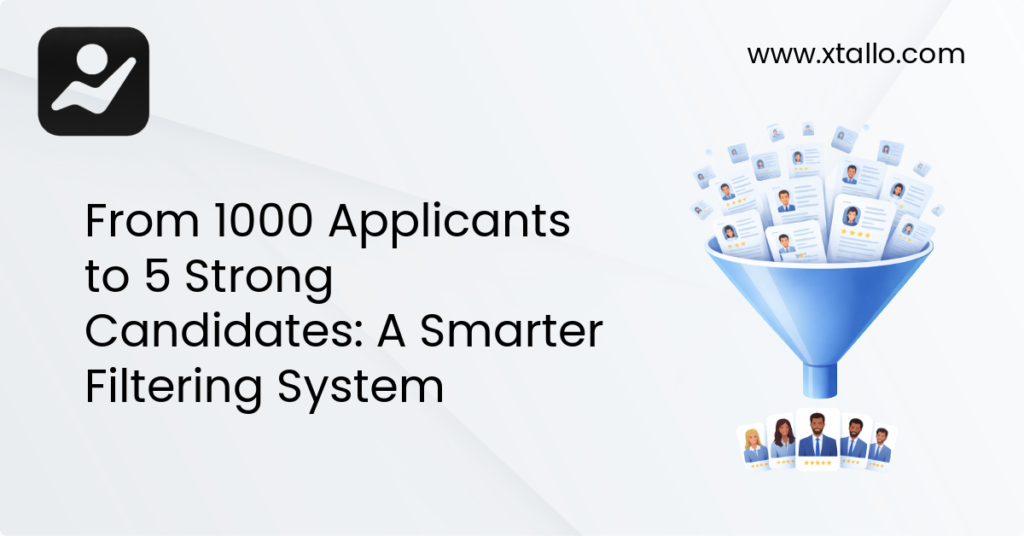
How You Go From 1000 → 5 Candidates
Stage 1: Eliminate Noise (1000 → 200)
Filter based on:
- Basic relevance
- Role alignment
- Experience type
👉 Remove obvious mismatches
Stage 2: Skill-Based Filtering (200 → 50)
Now filter for:
- Communication ability
- Sales understanding
- Confidence
👉 This is where most resumes fail
Stage 3: Real Performance Check (50 → 10)
Evaluate:
- Pitch delivery
- Objection handling
- Thinking ability
👉 Now you’re seeing real talent
Stage 4: Final Shortlist (10 → 3–5)
Select candidates based on:
- Consistency
- Clarity
- Closing mindset
👉 These are your true top performers
Funnel Comparison: Old vs Smart System
| Stage | Traditional Hiring | Smart Filtering |
|---|---|---|
| Applicants | 1000 | 1000 |
| After Screening | 300 random | 200 relevant |
| After Interviews | 50 inconsistent | 50 skill-validated |
| Final Candidates | 10–15 average | 3–5 high-quality |
| Hiring Confidence | Low | High |
The Key Shift: From Volume to Precision
Old mindset:
👉 “Let’s review more profiles”
New mindset:
👉 “Let’s filter smarter”
Because:
- Time is limited
- Attention is limited
- Hiring mistakes are expensive
Where Xtallo Changes the Game
Xtallo is designed exactly for this problem.
Instead of:
❌ Endless resumes
You get:
✅ Video-first profiles
✅ Real skill visibility
✅ Tier-based talent (Top 1%, Top 3%, etc.)
Xtallo Advantage in Filtering
| Feature | Traditional Platforms | Xtallo |
|---|---|---|
| Profile Type | Resume | Video + proof |
| Skill Visibility | Low | High |
| Filtering Speed | Slow | Fast |
| Candidate Quality | Mixed | Pre-filtered |
| Decision Confidence | Low | Strong |
Why This Matters for Growing Companies
If you fix filtering:
- Hiring becomes faster
- Teams become stronger
- Revenue becomes predictable
If you don’t:
- You waste time
- You burn budget
- You keep rehiring
Final Thought
The goal is not to hire more people.
👉 The goal is to hire the right 3–5 people faster.
Because:
- 1 strong salesperson > 5 average ones
- 1 right hire > months of hiring effort