
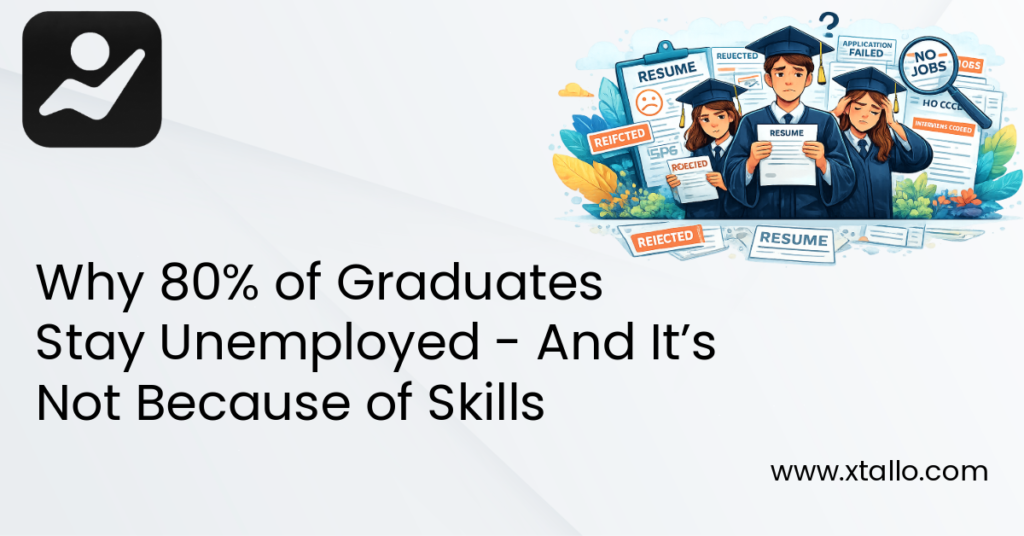
Every year millions of graduates enter the job market with hope, degrees, and expectations. Yet a shocking reality hits them soon after: most struggle to find meaningful employment.
Across many countries, studies and employment reports repeatedly show a worrying trend – a huge percentage of graduates remain unemployed or underemployed for months, sometimes years after graduation.
The surprising truth?
The problem isn’t skills.
Many graduates are capable, hardworking, and educated. The real issue lies deeper in how talent is presented, evaluated, and discovered in modern hiring systems.
Let’s break down the real reasons behind graduate unemployment and what needs to change.
The Graduate Employment Parado
Universities are producing more graduates than ever before.
Industries are also growing and constantly looking for talent.
Yet somehow, companies say they can’t find the right people, while graduates say companies aren’t hiring them.
This contradiction creates what many experts call the “employment paradox.”
Companies receive thousands of resumes, but most hiring managers still struggle to identify candidates who truly stand out.
The problem is not talent – it’s visibility and differentiation.
The Resume System Is Broken
For decades, hiring has depended on one thing: the resume.
A document meant to summarize a person’s abilities, experience, and education.
But today’s job market is far more competitive and complex than when resumes first became standard.
Here’s the issue:
A resume is static.
It cannot show:
- Communication ability
- Confidence
- Personality
- Problem-solving mindset
- Real passion for work
Two candidates may have identical resumes, but one might be 10 times more capable in real life.
Unfortunately, hiring managers cannot see that difference through a document.
This leads to mass filtering, keyword scanning, and automated rejection.
Talented graduates often disappear in the pile.
Graduates Are Invisible in the Hiring Process
Most companies receive hundreds or even thousands of applications for a single role.
Because of this, recruiters rely on Applicant Tracking Systems (ATS) that scan resumes automatically.
If a resume doesn’t contain the right keywords or formatting, it gets rejected before a human ever sees it.
This means many qualified graduates never even reach the interview stage.
They are not rejected because they lack skills.
They are rejected because the system cannot recognize their potential.
Universities Teach Knowledge, Not Positioning
Another reason graduates struggle is because education focuses on knowledge, not career positioning.
Students learn:
- Theory
- Technical concepts
- Academic frameworks
But rarely learn how to:
- Present themselves professionally
- Demonstrate value to companies
- Build a personal professional identity
- Communicate impact and achievements
In the modern hiring landscape, how you present your ability matters as much as the ability itself.
Graduates who understand this often secure opportunities faster.
Companies Want Proof, Not Just Claims
Recruiters today are overwhelmed with applications.
Because of this, companies increasingly prefer proof of capability rather than written claims.
Statements like these appear on almost every resume:
- “Hardworking team player”
- “Excellent communication skills”
- “Strong leadership ability”
But companies ask a simple question:
Where is the proof?
Without visible demonstrations of skills — such as real work samples, projects, or presentations — these claims carry little weight.
The Rise of Skills Visibility
The hiring landscape is slowly shifting toward skills visibility.
Instead of relying only on written resumes, companies now value candidates who can demonstrate what they can do.
This can include:
- Portfolio projects
- Recorded presentations
- Case study explanations
- Problem-solving demonstrations
- Video introductions
These formats allow companies to quickly understand how a candidate thinks, communicates, and performs.
It creates a more human and transparent hiring process.
Why Video Profiles Are Changing Hiring
One of the biggest emerging trends in hiring is video-first candidate profiles.
Instead of only submitting resumes, candidates introduce themselves through short professional videos.
This allows companies to instantly evaluate:
- Communication skills
- Confidence
- Professional presence
- Industry understanding
- Personality fit
Within just a few minutes, recruiters gain insights that a resume could never provide.
For graduates, this dramatically increases the chance of standing out.
The Shift Toward Talent Marketplaces
Another major shift happening in hiring is the move toward talent marketplaces.
These platforms focus on discovering talent rather than filtering resumes.
Companies can browse candidates based on:
- skills
- specialization
- industry expertise
- demonstrated ability
Instead of applying blindly to hundreds of jobs, candidates can present themselves clearly and attract opportunities.
This model benefits both sides.
Companies discover talent faster, and candidates gain better visibility.
What Graduates Should Do Differently
To succeed in the modern job market, graduates must rethink how they approach their careers.
Here are a few strategies that make a real difference:
Build a Professional Identity
Focus on positioning yourself around a clear skill set or specialization rather than presenting yourself as “open to anything.”
Showcase Real Work
Create small projects, case studies, or demonstrations that show your capabilities.
Communicate Your Value
Learn how to explain what you can contribute to a company in practical terms.
Use Modern Professional Profiles
Adopt platforms that allow richer presentations of talent rather than relying solely on resumes.
The Future of Hiring
The traditional hiring system is slowly evolving.
Companies are realizing that resumes alone cannot capture human potential.
New hiring approaches are emerging that focus on:
- skills visibility
- communication ability
- real problem-solving capability
- authentic professional identity
Graduates who adapt to this shift will gain a major advantage in the job market.
Conclusion
Graduate unemployment is often misunderstood.
It is easy to assume that graduates struggle because they lack skills. But in many cases, the real issue is how talent is discovered and evaluated.
Resumes hide potential instead of revealing it.
Modern hiring needs better ways to showcase real ability, communication, and professional presence.
As hiring continues to evolve, platforms that enable candidates to present themselves beyond traditional resumes will play an important role in bridging the gap between talent and opportunity.
For graduates entering the workforce today, the key is simple:
Don’t just list your skills. Show them.