
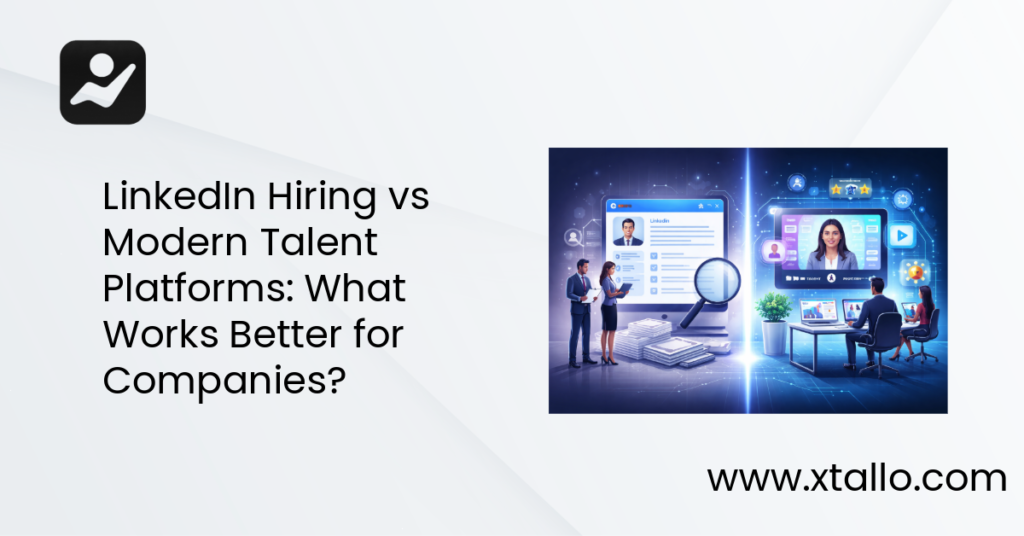
Hiring has changed dramatically over the past decade. A few years ago, most companies relied heavily on job portals and LinkedIn to find talent. Today, the landscape is evolving fast. Businesses are now exploring modern talent platforms that promise faster hiring, verified candidates, and deeper insight into candidate abilities.
For companies scaling teams, the question is no longer “Where do we post a job?” but rather:
“Which hiring system actually helps us identify the right talent quickly?”
This article breaks down the differences between LinkedIn hiring and modern talent platforms, showing what works better for companies that want efficiency, accuracy, and high-quality hires.
Understanding LinkedIn Hiring
LinkedIn has become one of the most popular professional networks in the world. It provides companies access to millions of professionals, making it a powerful tool for sourcing candidates.
Most organizations use LinkedIn for:
- Posting job openings
- Searching for professionals using filters
- Reviewing resumes and experience
- Contacting candidates through direct messages
- Employer branding
LinkedIn works extremely well for visibility and networking, but companies often face challenges when using it as a full hiring system.
LinkedIn Hiring Overview
| Feature | Description |
|---|---|
| Talent Pool | Millions of professionals across industries |
| Hiring Method | Resume-based applications |
| Screening Process | Manual review by recruiters |
| Communication | LinkedIn messages or email |
| Candidate Verification | Limited verification |
| Speed of Hiring | Often slow due to volume |
| Candidate Insights | Mostly resume and profile data23 |
What Are Modern Talent Platforms?
Modern talent platforms are designed to solve many problems companies face with traditional hiring methods. Instead of relying only on resumes, these platforms combine technology, video profiles, skills testing, and structured screening.
Many platforms focus on quality over quantity, helping companies identify serious candidates faster.
Modern hiring platforms typically include:
- Video introductions
- Skill-based evaluations
- Verified experience
- Structured candidate profiles
- AI-assisted screening
- Talent ranking systems
These platforms aim to help companies hire faster and with greater confidence.
Modern Talent Platforms Overview
| Feature | Description |
|---|---|
| Talent Pool | Curated or verified professionals |
| Hiring Method | Skill-based and profile-based |
| Screening Process | Pre-screened or platform-assisted |
| Communication | Platform messaging and interview scheduling |
| Candidate Verification | Higher verification standards |
| Speed of Hiring | Faster due to filtering systems |
| Candidate Insights | Video introductions, portfolios, skills |
LinkedIn vs Modern Talent Platforms: Key Differences
Companies often assume both options work the same way, but the hiring experience is very different.
1. Talent Discovery
| Factor | LinkedIn Hiring | Modern Talent Platforms |
|---|---|---|
| Talent Volume | Very large pool | Smaller but curated pool |
| Candidate Quality | Mixed quality | Higher average quality |
| Discovery Method | Keyword search | Skill matching and filters |
| Talent Visibility | Anyone with a profile | Often screened professionals |
2. Candidate Evaluation
| Factor | LinkedIn Hiring | Modern Talent Platforms |
|---|---|---|
| Profile Format | Resume-style profile | Structured talent profile |
| Skill Verification | Mostly self-declared | Often verified |
| Work Samples | Optional | Frequently required |
| Video Introduction | Rare | Common feature |
3. Hiring Speed
| Factor | LinkedIn Hiring | Modern Talent Platforms |
|---|---|---|
| Application Volume | Very high | Controlled |
| Screening Effort | Heavy manual review | Platform-assisted filtering |
| Interview Scheduling | Manual coordination | Integrated scheduling |
| Hiring Time | Often weeks | Potentially days |
4. Candidate Engagement
| Factor | LinkedIn Hiring | Modern Talent Platforms |
|---|---|---|
| Candidate Intent | Mixed (browsing + active job seekers) | Usually active job seekers |
| Response Rate | Often low | Higher engagement |
| Communication | Messaging based | Structured interview process |
5. Hiring Transparency
| Factor | LinkedIn Hiring | Modern Talent Platforms |
|---|---|---|
| Candidate Insights | Resume + posts | Video, skills, portfolio |
| Hiring Signals | Limited | Detailed profile signals |
| Professional Context | Networking focused | Hiring focused |
Advantages of LinkedIn Hiring
Despite its limitations, LinkedIn still offers several benefits for companies.
Strengths of LinkedIn
| Advantage | Explanation |
|---|---|
| Massive professional network | Access to professionals globally |
| Employer branding | Companies can build strong brand presence |
| Networking opportunities | Ability to connect beyond hiring |
| Passive candidate discovery | Recruit professionals not actively job hunting |
| Industry insights | News, posts, and thought leadership |
LinkedIn works especially well for leadership roles, networking-driven hiring, and employer branding strategies.
Advantages of Modern Talent Platforms
Modern hiring platforms are designed for efficiency and hiring accuracy.
Strengths of Modern Talent Platforms
| Advantage | Explanation |
|---|---|
| Faster candidate filtering | Pre-screened or ranked talent |
| Skill-based hiring | Focus on proven ability rather than job titles |
| Video introductions | Quick personality and communication assessment |
| Structured profiles | Clear and comparable candidate information |
| Reduced hiring risk | Better candidate validation |
These platforms are particularly useful for companies that need to hire quickly or evaluate many candidates efficiently.
Challenges Companies Face with LinkedIn Hiring
Many companies encounter several operational challenges when hiring through LinkedIn.
Common LinkedIn Hiring Challenges
| Challenge | Impact on Companies |
|---|---|
| Too many applications | Hard to identify quality candidates |
| Resume exaggeration | Difficulty verifying skills |
| Low response rates | Slow hiring communication |
| Manual screening | Recruiters spend significant time reviewing profiles |
| Lack of structured evaluation | Hard to compare candidates objectively |
These challenges often lead companies to explore more structured hiring solutions.
Challenges of Modern Talent Platforms
While modern platforms solve many problems, they also have certain limitations.
Common Platform Limitations
| Challenge | Explanation |
|---|---|
| Smaller candidate pools | Limited compared to global networks |
| Platform dependency | Companies rely on platform systems |
| Learning curve | HR teams may need new workflows |
| Platform fees | Some services charge premium access |
Despite these limitations, many companies prefer quality-driven hiring environments.
Which One Works Better for Companies?
The answer depends on the hiring goal.
When LinkedIn Works Best
| Scenario | Reason |
|---|---|
| Employer branding | Large audience reach |
| Passive candidate discovery | Access to professionals not actively applying |
| Executive networking | Strong professional network ecosystem |
When Modern Talent Platforms Work Best
| Scenario | Reason |
|---|---|
| Fast hiring | Pre-filtered candidates |
| Skill-based roles | Strong evaluation systems |
| Freelancers or specialists | Portfolio-driven hiring |
| Startups scaling teams | Faster talent discovery |
The Future of Hiring
Hiring is gradually shifting from resume-based evaluation to proof-based evaluation.
Companies increasingly want:
- Demonstrated skills
- Real work samples
- Communication ability
- Cultural fit insights
This is why video profiles, portfolio-based hiring, and structured talent platforms are becoming more common.
Conclusion
LinkedIn remains a powerful professional network and a useful hiring tool. However, as companies seek faster and more accurate hiring systems, modern talent platforms are gaining traction.
The future of recruitment is likely to combine both approaches:
- Networking and discovery through professional platforms
- Structured evaluation through modern talent platforms
For companies looking to reduce hiring friction and identify high-performing professionals quickly, the next generation of hiring platforms is becoming an essential part of the recruitment ecosystem.