
Introduction
Most companies think hiring fails because:
- There’s not enough talent
- Candidates aren’t good enough
- Market is too competitive
But the truth is uncomfortable:
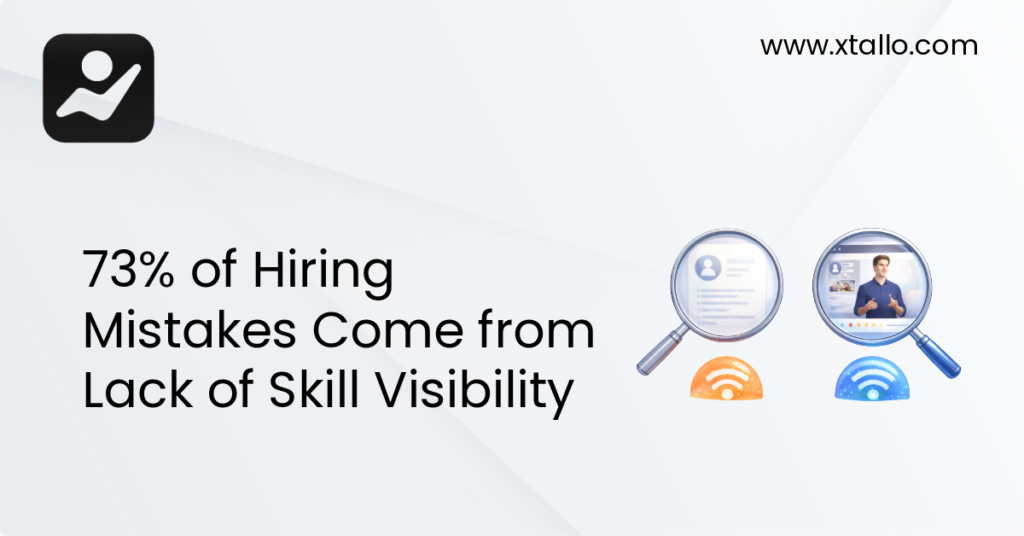
👉 73% of hiring mistakes happen because companies can’t actually see real skills
They’re not hiring wrong people…
👉 They’re hiring without clarity.
The Core Problem: Lack of Skill Visibility
| Hiring Stage | What Companies See | What They Miss |
|---|---|---|
| Resume | Past roles | Real execution ability |
| Portfolio | Final output | Thinking process |
| Interview | Communication | Problem-solving depth |
| References | Opinions | Current performance |
👉 Result: Decisions made on incomplete data
What “Lack of Skill Visibility” Really Means
It means:
- You don’t know how the candidate thinks
- You haven’t seen them perform
- You’re relying on assumptions
👉 You’re hiring based on signals, not proof
Visible vs Invisible Skills
| Skill Type | Visibility in Traditional Hiring | Actual Importance |
|---|---|---|
| Communication | High | Medium |
| Experience | High | Medium |
| Problem Solving | Low | Very High |
| Execution Ability | Low | Very High |
| Decision Making | Low | High |
👉 The most important skills are the least visible.
Why This Leads to 73% Hiring Mistakes
1. Over-reliance on Resumes
Resumes:
- Show history
- Not real ability
👉 Everyone looks similar.
2. Interviews Reward Confidence, Not Capability
Candidates who:
- Speak well
- Structure answers
Win interviews—even if they lack depth.
3. No Real Skill Demonstration
Most companies:
❌ Don’t test real scenarios
❌ Don’t evaluate thinking
👉 They “guess” talent.
Resume-Based Hiring vs Skill Visibility-Based Hiring
| Factor | Resume-Based Hiring | Skill Visibility-Based Hiring |
|---|---|---|
| Evaluation | Surface-level | Deep |
| Skill Insight | Limited | Clear |
| Decision Confidence | Low | High |
| Hiring Accuracy | Inconsistent | Strong |
| Risk Level | High | Reduced |
The Cost of Poor Skill Visibility
| Impact Area | Result |
|---|---|
| Revenue | Missed targets |
| Time | Wasted onboarding |
| Team | Misalignment |
| Hiring Cost | Increased due to rehiring |
👉 One wrong hire = months of lost progress.
Before vs After Skill Visibility
| Scenario | Without Skill Visibility | With Skill Visibility |
|---|---|---|
| Candidate Clarity | Low | High |
| Hiring Speed | Slow | Fast |
| Decision Accuracy | Risky | Reliable |
| Team Performance | Inconsistent | Strong |
| Hiring Confidence | Weak | High |
How to Fix This Problem
1. Move from Claims to Proof
Stop asking:
👉 “What have you done?”
Start asking:
👉 “Show me how you did it”
2. Introduce Video-Based Evaluation
Video reveals:
- Thinking
- Communication
- Confidence
👉 Instantly.
3. Use Real Scenarios
Test candidates with:
- Case problems
- Live situations
- Practical tasks
4. Track Performance Signals Over Time
Don’t rely on:
👉 One interview
Use:
👉 Continuous evaluation
Traditional Hiring vs Visibility-Driven Hiring
| Factor | Traditional Hiring | Visibility-Driven Hiring |
|---|---|---|
| Skill Insight | Low | High |
| Differentiation | Weak | Strong |
| Hiring Speed | Slow | Fast |
| Error Rate | High | Reduced |
| Team Outcome | Unstable | High-performing |
Where Xtallo Changes the Game
Xtallo is built to solve exactly this problem.
Instead of:
❌ Guessing talent
You get:
✅ Video-first profiles (see real communication)
✅ Proof-based work visibility
✅ Continuous performance signals
👉 You don’t hire blindly anymore.
The Bigger Shift
Hiring is moving from:
❌ Hidden skills → Visible skills
❌ Assumptions → Evidence
❌ Interviews → Demonstrations
Final Thought
The biggest hiring mistake is not:
👉 Choosing the wrong candidate
It’s:
👉 Not seeing the right candidate clearly
Because:
👉 You can’t hire what you can’t see.