
Introduction
Most founders think like this:
👉 “Let’s save cost on hiring developers”
It sounds smart.
It feels efficient.
But here’s the brutal truth:
👉 Cheap developers don’t reduce cost-they multiply it
In many real scenarios:
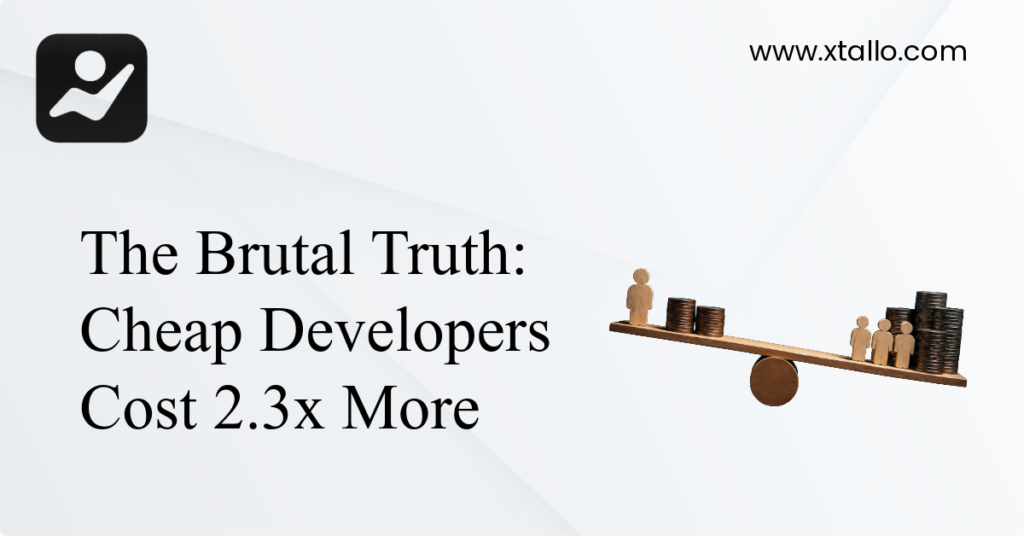
👉 They end up costing 2.3x more than hiring the right talent upfront.
Cheap vs High-Quality Developers (Real Cost Comparison)
| Factor | Cheap Developers | High-Quality Developers |
|---|---|---|
| Initial Salary | Low | Higher |
| Code Quality | Inconsistent | High |
| Bug Rate | High | Low |
| Rework Needed | Frequent | Minimal |
| Delivery Speed | Slow | Fast |
| Ownership | Low | High |
| Final Cost | 2.3x higher | Optimized |
Where the Extra 2.3x Cost Comes From
1. Rework & Fixes
Cheap developers often:
- Write unstable code
- Miss edge cases
- Create technical debt
👉 Result:
- Same work gets done 2–3 times
Rework Cost Impact
| Area | Cheap Dev Impact |
|---|---|
| Bug Fixing Time | +60–90% |
| Refactoring | Frequent |
| QA Load | Increased |
| Developer Overlap | Required |
2. Slow Execution
Cheap doesn’t mean fast.
It usually means:
- More time to understand
- More time to execute
- More time to fix
👉 Time loss = cost loss
3. Technical Debt Explosion
This is the silent killer.
Bad code leads to:
- Poor scalability
- Performance issues
- Future rebuilds
👉 You pay later—and much more.
Short-Term Savings vs Long-Term Cost
| Phase | Cheap Hiring | Quality Hiring |
|---|---|---|
| Month 1 | Lower cost | Higher cost |
| Month 3 | Issues start | Stable growth |
| Month 6 | Rework required | Scalable system |
| Month 12 | Rebuild needed | Optimized product |
👉 Cheap hiring wins early
👉 Quality hiring wins always
4. Team Productivity Drops
One weak developer impacts:
- Other developers
- QA teams
- Product timelines
👉 Entire team slows down
5. Opportunity Cost (Most Ignored)
This is where real loss happens.
While fixing problems:
- You’re not building new features
- You’re not scaling
- You’re not innovating
👉 Lost time = lost revenue
True Cost Breakdown
| Cost Type | Cheap Developer | Real Impact |
|---|---|---|
| Salary | Low | Misleading |
| Rework | High | Expensive |
| Delays | High | Revenue loss |
| Team Impact | Negative | Productivity drop |
| Final Output | Weak | Poor ROI |
Why Founders Fall Into This Trap
1. They Optimize for Cost, Not Output
They ask:
👉 “How much does this cost?”
Instead of:
👉 “What output will this generate?”
2. They Can’t Evaluate Technical Skill Properly
So they rely on:
- Resume
- Rate
- Availability
👉 Not real capability
3. They Ignore Proof
They don’t see:
- Code quality
- Thinking ability
- Problem-solving approach
👉 They guess—and pay later
Resume-Based Hiring vs Proof-Based Hiring
| Factor | Resume-Based Hiring | Proof-Based Hiring |
|---|---|---|
| Skill Visibility | Low | High |
| Hiring Accuracy | Medium | High |
| Risk | High | Reduced |
| Cost Efficiency | Poor | Strong |
| Outcome | Unpredictable | Reliable |
The Real Shift: Cost → Value
Smart companies don’t ask:
👉 “Who is cheaper?”
They ask:
👉 “Who creates more value per hour?”
Where Xtallo Changes the Game
Xtallo solves this exact problem.
Instead of:
❌ Hiring based on cost
You get:
✅ Video-based proof of thinking
✅ Real performance visibility
✅ Tier-based talent (Top 1%, Top 3%)
Why This Matters
With Xtallo:
- You see how developers think
- You understand how they solve problems
- You reduce hiring mistakes
👉 You hire for output, not price
Cheap Hiring vs Smart Hiring
| Approach | Cheap Hiring | Smart Hiring |
|---|---|---|
| Focus | Cost | Value |
| Decision | Price-driven | Performance-driven |
| Risk | High | Low |
| Outcome | Expensive mistakes | Scalable growth |
Final Thought
The biggest myth in hiring is:
👉 “Cheap saves money”
The truth is:
👉 Cheap delays growth and multiplies cost
Because in the long run:
👉 You don’t pay for the developer
👉 You pay for the decisions they make