
Introduction
Ratings look powerful.
- ⭐ 4.8 stars
- “Top rated” badge
- Dozens of reviews
It feels like:
👉 Trust
👉 Proof
👉 Quality
But here’s the uncomfortable truth:
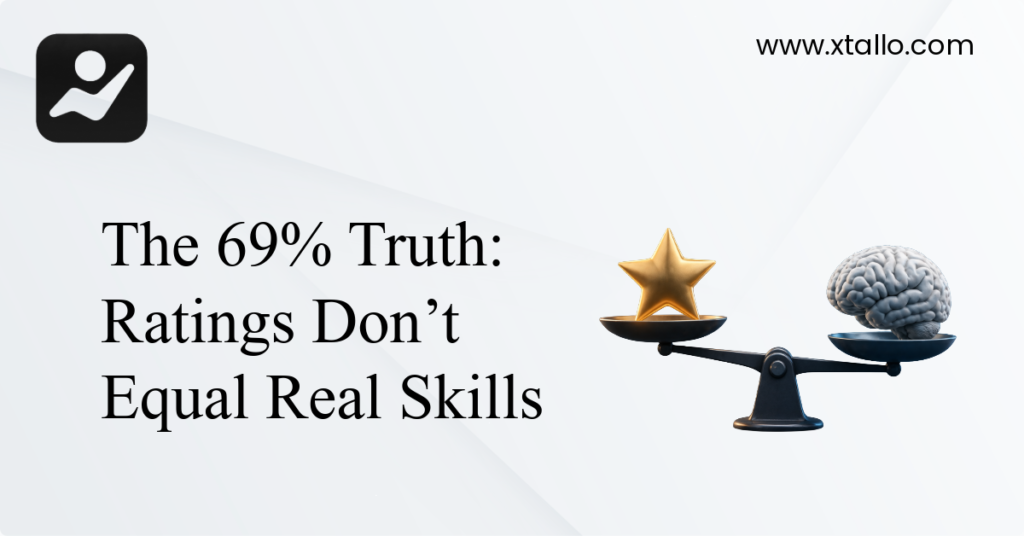
👉 In up to 69% of cases, ratings do not reflect real skill level
And companies relying on ratings for hiring are:
- Making biased decisions
- Missing better talent
- Overpaying average performers
Ratings vs Real Skills (Reality Check)
| Factor | Ratings-Based Evaluation | Skill-Based Evaluation |
|---|---|---|
| What it measures | Past feedback | Actual capability |
| Accuracy | Medium–Low | High |
| Bias level | High | Low |
| Context clarity | Missing | Detailed |
| Trust level | Perceived | Verified |
| Decision quality | Risky | Reliable |
Why Ratings Mislead Companies
1. Ratings Reflect Experience, Not Ability
A candidate may have:
- Good communication
- Friendly behavior
But not:
👉 Strong execution
👉 Deep problem-solving
👉 Ratings reward experience, not always performance
2. Context Is Missing
A 5-star rating doesn’t tell:
- What problem was solved
- How complex the work was
- What role the candidate played
👉 Without context, ratings are incomplete signals
3. Ratings Are Often Inflated
Rating Inflation Reality
| Platform Behavior | Impact |
|---|---|
| Clients avoid giving low ratings | Artificially high averages |
| Short-term projects get high scores | No long-term validation |
| Bias toward politeness | Skill ignored |
👉 Result: Everyone looks “above average”
4. No Visibility Into Thinking
Ratings don’t show:
- Decision-making
- Strategy
- Problem-solving approach
👉 And that’s where real skill lives
Rating Signal vs Real Skill Signal
| Signal Type | Example | Reliability |
|---|---|---|
| Star Rating | 4.7/5 | Medium |
| Written Review | “Great work” | Medium |
| Portfolio Output | Final result | Medium |
| Video Explanation | Thought process | High |
| Live Task | Real execution | Very High |
The Real Risk of Hiring Based on Ratings
| Area | Impact |
|---|---|
| Hiring Accuracy | Drops |
| Talent Quality | Inconsistent |
| Cost Efficiency | Poor |
| Team Performance | Unstable |
| Growth | Slower |
👉 Ratings create false confidence
High-Rated Candidate vs Proven Candidate
| Factor | High-Rated Candidate | Proven Candidate |
|---|---|---|
| Reviews | Strong | Moderate |
| Skill Visibility | Low | High |
| Thinking Ability | Unknown | Clear |
| Performance Proof | Missing | Present |
| Hiring Confidence | Illusion | Real |
Why Companies Still Trust Ratings
Because ratings are:
- Easy to understand
- Quick to compare
- Widely available
👉 But easy doesn’t mean accurate.
The Shift: From Ratings to Proof
Hiring is evolving from:
❌ “What do others say about you?”
➡️
✅ “Show me what you can do”
Ratings-Based Hiring vs Proof-Based Hiring
| Factor | Ratings-Based Hiring | Proof-Based Hiring |
|---|---|---|
| Decision Basis | Feedback | Demonstration |
| Transparency | Low | High |
| Skill Clarity | Limited | Clear |
| Risk | High | Reduced |
| Outcome | Unpredictable | Reliable |
Where Xtallo Changes the Game
Xtallo moves hiring beyond ratings.
Instead of:
❌ Star-based trust
You get:
✅ Video-based proof of thinking
✅ Real work breakdowns
✅ Performance visibility
👉 You don’t rely on opinions
👉 You rely on evidence
The Bigger Insight
Ratings are:
👉 A social signal
Skills are:
👉 A performance signal
And confusing the two is where hiring breaks.
Final Thought
The biggest mistake companies make is this:
👉 Trusting how candidates are rated
Instead of:
👉 Understanding how they perform
Because in the future:
👉 Ratings will be secondary
👉 Proof will be primary