
Introduction
Video hiring is everywhere.
- Intro videos
- Recorded answers
- Video resumes
And companies assume:
👉 “If we use video, hiring will improve”
But reality says something else:
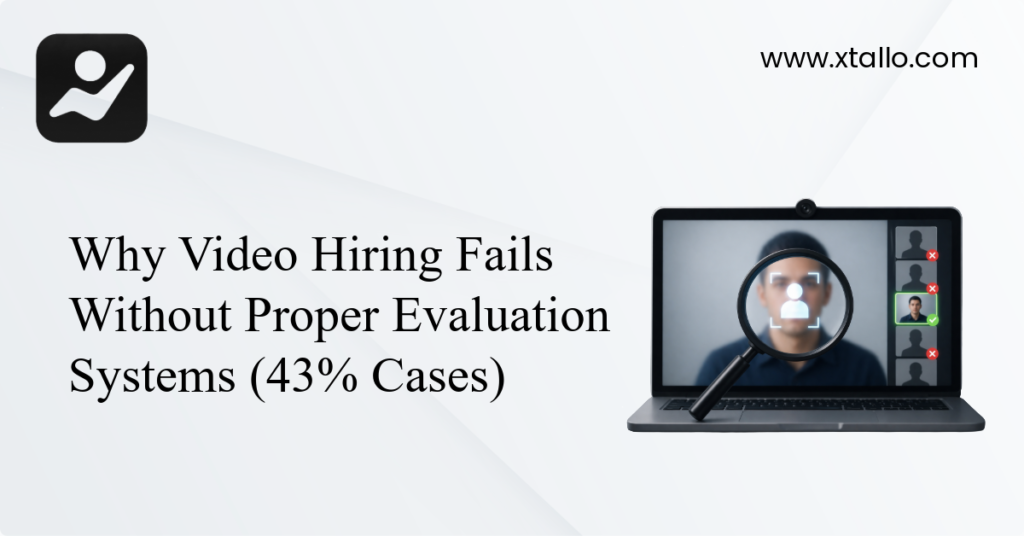
👉 Up to 43% of video-based hiring still fails
Why?
Because video alone is not a system.
👉 It’s just a format.
Video Hiring Adoption vs Success
| Factor | Without Proper System | With Proper System |
|---|---|---|
| Hiring Accuracy | Low–Medium | High |
| Candidate Evaluation | Surface-level | Deep |
| Decision Confidence | Unstable | Strong |
| Hiring Outcome | Inconsistent | Predictable |
| Failure Rate | ~43% | Significantly reduced |
The Core Problem
Most companies use video like this:
- “Record a short intro”
- “Answer these questions”
And then:
👉 Make decisions based on impression
Why Video Hiring Fails (Real Reasons)
1. No Evaluation Framework
Video shows:
- Communication
- Confidence
But without structure:
👉 You don’t know what to evaluate
2. Bias Increases Without Structure
Without proper criteria:
- Charismatic candidates win
- Skilled but quiet candidates lose
👉 Decisions become subjective
3. No Skill Validation
Video answers:
❌ What candidates say
But not:
👉 What they can actually do
4. One-Time Interaction Problem
Most video hiring is:
👉 One recording → One decision
But real performance requires:
👉 Multiple signals over time
Raw Video Hiring vs Structured Video Hiring
| Factor | Raw Video Hiring | Structured Video Hiring |
|---|---|---|
| Evaluation Criteria | Undefined | Clearly defined |
| Skill Validation | Weak | Strong |
| Bias Control | Low | High |
| Decision Accuracy | Medium | High |
| Hiring Confidence | Risky | Reliable |
What a Proper Video Evaluation System Looks Like
1. Defined Scoring Metrics
You must evaluate:
- Communication clarity
- Problem-solving
- Domain knowledge
- Thinking structure
2. Scenario-Based Video Tasks
Instead of:
👉 Generic answers
Use:
👉 Real-world situations
3. Multi-Signal Evaluation
Don’t rely on:
👉 One video
Use:
👉 Multiple proofs:
- Case explanation
- Task walkthrough
- Real work breakdown
One Video vs Multi-Signal Evaluation
| Factor | Single Video | Multi-Signal System |
|---|---|---|
| Insight Depth | Low | High |
| Reliability | Medium | Strong |
| Decision Quality | Risky | Accurate |
| Skill Visibility | Partial | Complete |
Where the 43% Failure Comes From
Breakdown of Failure Causes
| Reason | Contribution |
|---|---|
| Lack of structure | 18–22% |
| Bias in evaluation | 9–12% |
| No skill validation | 7–10% |
| Over-reliance on communication | 5–7% |
👉 The problem is not video.
👉 The problem is how video is used
Traditional Hiring vs Raw Video vs Structured Video
| Factor | Traditional Hiring | Raw Video Hiring | Structured Video System |
|---|---|---|---|
| Speed | Slow | Fast | Fast |
| Accuracy | Low | Medium | High |
| Trust | Weak | Medium | Strong |
| Skill Visibility | Low | Partial | High |
| Outcome | Inconsistent | Risky | Predictable |
The Real Shift
From:
❌ Video as a feature
To:
✅ Video as part of a system
Where Xtallo Changes the Game
Xtallo doesn’t just use video.
It builds:
👉 A structured evaluation system around video
Instead of:
❌ Random video submissions
You get:
✅ Video + proof + performance signals
✅ Tier-based talent filtering
✅ Clear evaluation frameworks
Why This Works
- Video gives visibility
- Structure gives accuracy
- Proof gives trust
👉 Together, they create reliable hiring
Final Thought
The biggest mistake companies make:
👉 Adding video to a broken system
Instead of:
👉 Building a system around video
Because in the future:
👉 Video won’t win
👉 Systems built around video will