
Introduction
Most hiring decisions today are based on conversations.
- Interviews
- Q&A rounds
- Hypothetical scenarios
But here’s the problem:
👉 Talking about work is not the same as doing work
And that’s why:
- Wrong hires happen
- Performance drops
- Teams struggle
A growing shift in hiring shows:
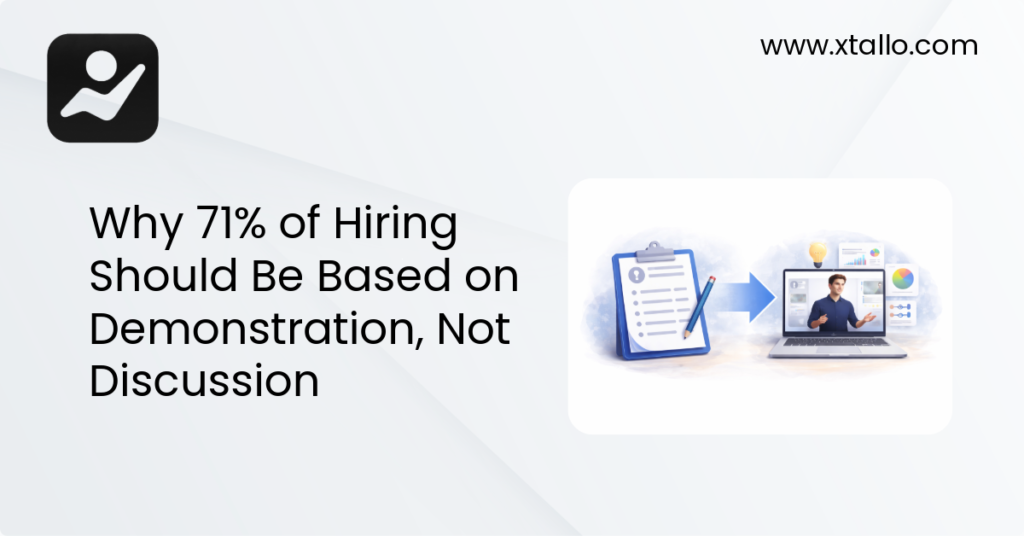
👉 Up to 71% of hiring decisions should be based on demonstration, not discussion
Discussion-Based Hiring vs Demonstration-Based Hiring
| Factor | Discussion-Based Hiring | Demonstration-Based Hiring |
|---|---|---|
| Evaluation Style | Talking | Doing |
| Skill Visibility | Low | High |
| Reliability | Medium | Very High |
| Bias Risk | High | Lower |
| Decision Accuracy | ~45–55% | ~70–80%+ |
| Confidence in Hire | Uncertain | Strong |
What Does “71% Based on Demonstration” Mean?
It means:
👉 The majority of hiring decisions should rely on:
- Real work samples
- Live problem-solving
- Video explanations
- Scenario-based execution
Not just:
- Answers
- Claims
- Opinions
Impact Comparison
| Area | Discussion-Based Hiring | Demonstration-Based Hiring |
|---|---|---|
| Wrong Hire Rate | High (30–50%) | Significantly reduced |
| Time to Productivity | Slow | Faster |
| Hiring Confidence | Medium | High |
| Team Performance | Inconsistent | Strong |
| Retention Rate | Lower | Higher |
Why Discussion-Based Hiring Fails
1. It Rewards Talkers, Not Performers
Some candidates:
- Speak confidently
- Structure answers well
But:
👉 They may not perform in real scenarios
2. Hypothetical Answers ≠ Real Execution
When asked:
“How would you solve this?”
Candidates give:
👉 Ideal answers
But real work is:
👉 Messy, dynamic, pressure-driven
3. Interviews Are Controlled Environments
- Candidates prepare
- Questions are predictable
👉 Real jobs are not.
Talking vs Doing (Reality Gap)
| Scenario | What Happens in Interview | What Happens in Real Work |
|---|---|---|
| Problem Solving | Structured answers | Unpredictable situations |
| Communication | Prepared | Spontaneous |
| Decision Making | Theoretical | Pressure-based |
| Execution | Explained | Proven |
What Demonstration-Based Hiring Looks Like
Instead of asking:
❌ “Tell me how you would do it”
You ask:
✅ “Show me how you do it”
Examples of Demonstration
- Sales: Live pitch or objection handling
- Marketing: Campaign breakdown
- Developer: Code problem solving
- Strategist: Case explanation
Resume + Interview vs Demonstration Stack
| Layer | Traditional Hiring | Demonstration-Based Hiring |
|---|---|---|
| Resume | Yes | Optional |
| Interview | Yes | Limited |
| Video Explanation | No | Yes |
| Real Task | Rare | Core |
| Performance Signals | No | Yes |
Why Demonstration Improves Hiring by 71%
1. Real Skill Visibility
You see:
- Thinking
- Execution
- Communication
2. Reduced Assumptions
No guessing.
Only:
👉 Observed ability
3. Better Role Fit
You match:
👉 Skill → Role
Not:
👉 Resume → Role
Before vs After Demonstration-Based Hiring
| Scenario | Before (Discussion-Based) | After (Demonstration-Based) |
|---|---|---|
| Hiring Accuracy | Low | High |
| Decision Speed | Slow | Faster |
| Candidate Clarity | Limited | Clear |
| Risk | High | Reduced |
| Team Quality | Mixed | Strong |
Where Xtallo Fits In
Xtallo is built around this shift.
Instead of:
❌ Asking candidates to explain
You get:
✅ Video-based demonstrations
✅ Real work breakdowns
✅ Proof of execution
👉 You don’t just hear talent
👉 You experience it
The Bigger Shift
Hiring is evolving from:
❌ Discussion → Demonstration
❌ Opinion → Evidence
❌ Interview → Execution
Final Thought
The biggest hiring mistake is this:
👉 Believing what candidates say
The smartest companies do this instead:
👉 Trust what candidates show
Because in the future:
👉 You won’t hire the best speaker
👉 You’ll hire the best performer