
Introduction
Here’s a truth most companies don’t want to admit:
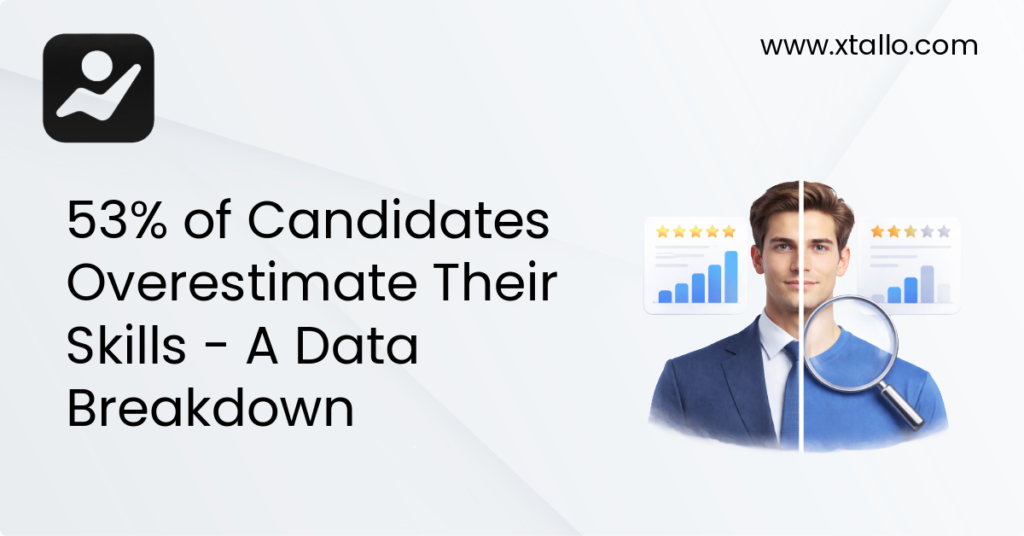
👉 More than 53% of candidates overestimate their skills
Not intentionally. Not maliciously.
But it happens-consistently.
And when hiring relies on:
- Self-reported skills
- Resume claims
- Interview answers
👉 You’re building decisions on inflated data
That’s where hiring starts to break.
The Skill Perception Gap
| Area | Candidate Belief | Actual Reality |
|---|---|---|
| Skill Level | “Above average” | Often average |
| Experience Impact | “Handled major work” | Limited ownership |
| Problem-Solving | “Strong” | Context-dependent |
| Communication | “Clear” | Inconsistent |
| Execution | “Efficient” | Needs guidance |
👉 This gap is called:
👉 Perception vs Performance Gap
Why 53% of Candidates Overestimate Themselves
1. Lack of Real Feedback
Most candidates:
- Don’t get honest feedback
- Work in isolated environments
👉 They assume they’re better than they are.
2. Resume Inflation Culture
Candidates are trained to:
- “Position strongly”
- “Sell themselves”
👉 Which leads to:
👉 Overstated capabilities
3. Interviews Reward Confidence
Confident candidates:
- Speak well
- Structure answers
👉 But confidence ≠ capability
Resume Claims vs Real Capability
| Evaluation Method | What It Shows | Accuracy |
|---|---|---|
| Resume | Claimed experience | Low |
| Interview | Verbal confidence | Medium |
| Portfolio | Output | Medium |
| Video Explanation | Thinking clarity | High |
| Live Task | Real execution | Very High |
The Hidden Cost of Overestimated Talent
| Impact Area | Result |
|---|---|
| Hiring Decisions | Wrong fit |
| Team Performance | Slows down |
| Project Quality | Drops |
| Time Cost | Rehiring cycles |
| Revenue Impact | Missed targets |
👉 One wrong hire ≠ one mistake
👉 It creates a chain reaction
Expected vs Actual Performance (Reality Check)
| Stage | Expected Performance | Actual Outcome |
|---|---|---|
| Hiring Stage | High confidence | Unverified |
| First Month | Strong delivery | Adjustment phase |
| 2–3 Months | Consistency expected | Gaps appear |
| 3–6 Months | Full performance | Underperformance risk |
Why Traditional Hiring Amplifies This Problem
1. It Trusts Self-Reported Data
👉 “I have done this”
👉 “I can handle that”
But:
❌ No real validation
2. It Doesn’t Test Real Scenarios
Most hiring:
- Talks about work
- Doesn’t simulate work
3. It Relies on One-Time Evaluation
👉 One interview
👉 One decision
That’s not enough to judge capability.
Traditional Hiring vs Reality-Based Hiring
| Factor | Traditional Hiring | Reality-Based (Proof) Hiring |
|---|---|---|
| Skill Evaluation | Self-reported | Demonstrated |
| Accuracy | Low | High |
| Confidence Level | Misleading | Validated |
| Risk | High | Reduced |
| Outcome | Inconsistent | Predictable |
How to Fix the 53% Problem
1. Shift from Claims to Proof
Instead of:
❌ “Tell me what you’ve done”
Ask:
✅ “Show me how you did it”
2. Use Video-Based Evaluation
Video reveals:
- Thinking
- Clarity
- Communication
👉 Things resumes can’t show
3. Introduce Real Task Simulation
Test:
- Real scenarios
- Real decision-making
👉 Not theoretical answers
Before vs After Fixing Skill Overestimation
| Scenario | Before (Traditional) | After (Proof-Based) |
|---|---|---|
| Skill Clarity | Low | High |
| Hiring Confidence | Misleading | Strong |
| Error Rate | High | Reduced |
| Performance Match | Inconsistent | Accurate |
| Team Quality | Mixed | High-performing |
Where Xtallo Fits In
Xtallo is built exactly for this gap.
Instead of:
❌ Trusting claims
You get:
✅ Video-first profiles
✅ Proof-based evaluation
✅ Real performance signals
👉 You don’t guess talent
👉 You see it
The Bigger Shift
Hiring is moving from:
❌ “How good do you think you are?”
➡️
✅ “Show me how good you actually are”
Final Thought
The biggest hiring risk is not:
👉 Lack of talent
It’s:
👉 Misjudging talent
And as long as hiring relies on:
- Resumes
- Interviews
- Self-assessment
👉 The 53% problem will continue.
But companies that shift to:
👉 Proof-based hiring
👉 Real performance signals
Will:
- Hire better
- Scale faster
- Build stronger teams