
Introduction
For decades, companies believed growth required:
👉 Full-time employees
👉 Long-term commitments
👉 Fixed salaries
But that model is breaking.
Fast-moving startups and modern companies are shifting toward:
👉 On-demand teams
Instead of hiring people permanently, they’re hiring:
- When needed
- For specific outcomes
- Based on skills—not contracts
Traditional Hiring vs On-Demand Teams
| Factor | Traditional Full-Time Hiring | On-Demand Teams |
|---|---|---|
| Commitment | Long-term | Flexible |
| Cost Structure | Fixed salaries | Pay for output |
| Hiring Speed | Slow | Fast |
| Scalability | Limited | Highly scalable |
| Risk | High (wrong hire = long-term loss) | Low (short-term engagement) |
| Flexibility | Low | High |
| Talent Access | Local or limited | Global |
Why On-Demand Teams Are Rising
1. Speed Is Everything
Startups can’t wait 2–3 months to hire.
They need:
👉 Execution now
👉 Results fast
On-demand teams allow:
- Instant onboarding
- Immediate contribution
2. Companies Want Outcomes, Not Headcount
Old mindset:
👉 “We need to hire more people”
New mindset:
👉 “We need to solve this problem”
On-demand hiring focuses on:
- Deliverables
- Results
- Performance
3. Cost Efficiency Without Compromise
Full-time hiring includes:
- Salary
- Benefits
- Infrastructure
- Long-term commitment
On-demand teams:
👉 Pay only for what you need
Cost Comparison: Full-Time vs On-Demand
| Cost Element | Full-Time Employee | On-Demand Talent |
|---|---|---|
| Salary | Fixed (monthly) | Variable (project-based) |
| Benefits | High | None |
| Risk | High (long-term) | Low |
| Productivity | Delayed (ramp time) | Immediate |
| ROI | Uncertain | Measurable |
What an On-Demand Team Looks Like
Instead of hiring:
- 1 full-time sales manager
- 1 marketer
- 1 SDR
You build a modular team:
- Sales closer (on demand)
- SDR (project-based)
- Marketing expert (campaign-based)
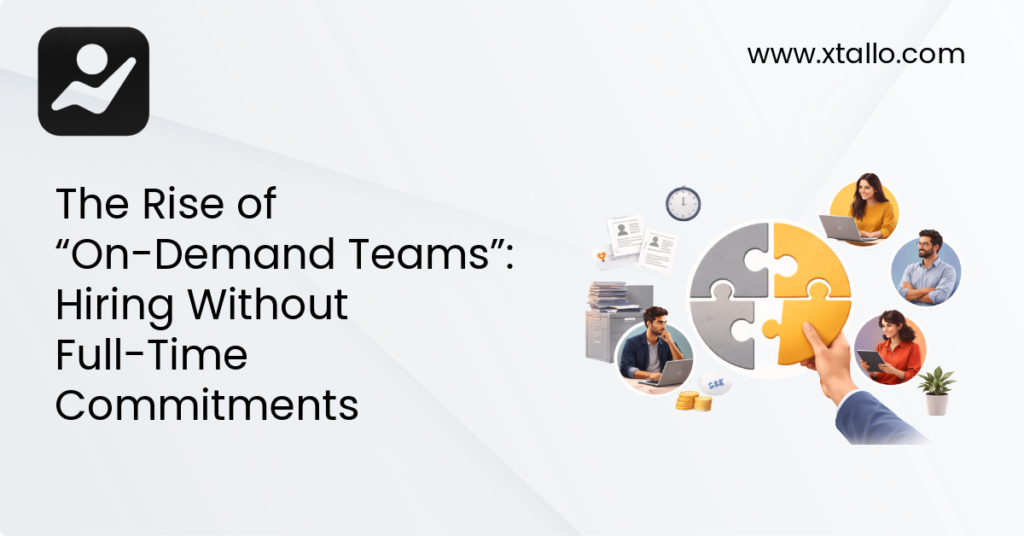
👉 You assemble talent like building blocks.
Fixed Team vs On-Demand Team Structure
| Aspect | Fixed Team | On-Demand Team |
|---|---|---|
| Team Size | Static | Dynamic |
| Skill Coverage | Limited | Specialized |
| Scaling | Slow | Instant |
| Cost | High | Optimized |
| Performance | Mixed | Task-focused |
The Biggest Challenge: Trust & Talent Quality
Let’s be real.
On-demand hiring fails when:
- Talent is unverified
- Skills are unclear
- Communication is weak
👉 This is why many companies struggle.
Freelance Hiring vs Structured On-Demand Hiring
| Factor | Random Freelancers | Structured On-Demand Teams |
|---|---|---|
| Talent Quality | Inconsistent | Curated |
| Verification | Low | High |
| Reliability | Uncertain | Predictable |
| Performance | Hit or miss | Outcome-driven |
| Scalability | Difficult | Easy |
The Shift: From Employees to Capability Access
Hiring is evolving from:
❌ “Who can we hire?”
➡️
✅ “What capability do we need right now?”
This is a massive shift.
Where Xtallo Fits In
Xtallo enables this new hiring model.
Instead of:
❌ Searching endlessly
❌ Guessing talent quality
You get:
✅ Video-first talent profiles
✅ Proof of skill before hiring
✅ Tier-based global experts (Top 1%, etc.)
Without Xtallo vs With Xtallo
| Factor | Without Xtallo | With Xtallo |
|---|---|---|
| Talent Discovery | Time-consuming | Instant access |
| Skill Visibility | Low | High (video proof) |
| Hiring Confidence | Low | High |
| Team Building | Slow | Fast & modular |
| Global Access | Limited | Seamless |
Why This Model Wins for Startups
Startups using on-demand teams:
- Move faster
- Spend smarter
- Access better talent
Startups using traditional hiring:
- Move slower
- Take more risk
- Get stuck in process
Final Thought
The future of hiring is not:
👉 Full-time vs freelance
It’s:
👉 Flexible, skill-first, on-demand teams
Because:
👉 Companies don’t need employees
👉 They need results