
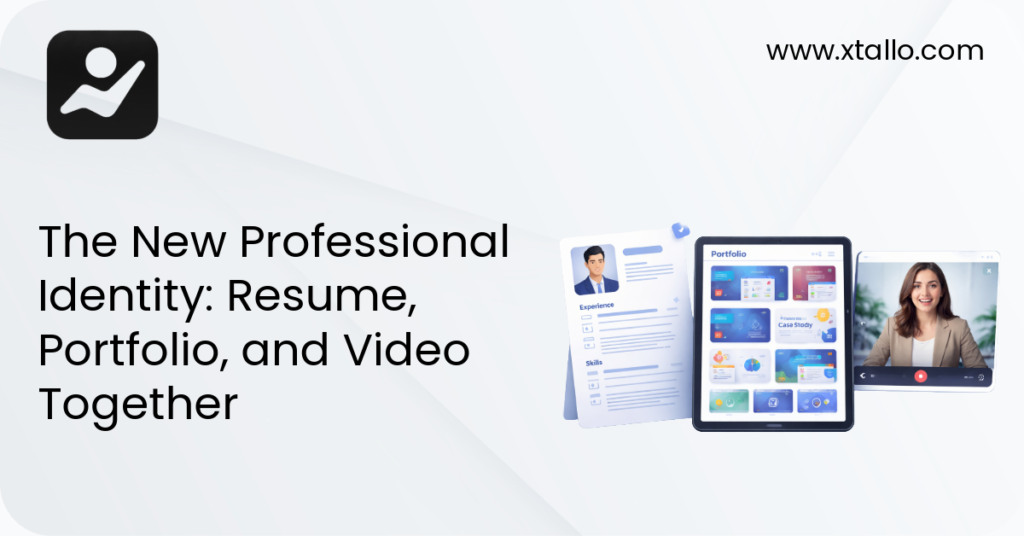
The professional world has quietly shifted.
Ten years ago, a resume was enough to introduce yourself to a company.
Today, companies want more than a list of experiences. They want to see:
- What you’ve built
- How you think
- How you communicate
- And what real impact you’ve created
This is why a new professional identity is emerging – one that combines Resume + Portfolio + Video.
Instead of relying on a static document, modern professionals now present a complete professional identity system that helps companies evaluate talent faster and more accurately.
This blog explains how these three elements work together and why companies increasingly prefer candidates who present themselves this way.
Why the Traditional Resume Alone Is No Longer Enough
Recruiters and founders receive hundreds of applications for a single role. Most resumes look nearly identical.
Typical problems with resumes today:
| Problem | Explanation |
|---|---|
| Lack of Proof | Resumes list responsibilities but rarely show real results. |
| Hard to Differentiate | Many candidates use similar wording and templates. |
| Limited Personality | A resume does not show communication ability or mindset. |
| No Context | Recruiters cannot see how a person actually works. |
| Static Format | A PDF cannot demonstrate projects, creativity, or strategy. |
Because of this, hiring managers increasingly look for additional signals of credibility.
That’s where portfolios and video introductions become powerful.
The Three Pillars of the Modern Professional Identity
The strongest candidates today combine three elements:
| Component | Purpose | What It Shows |
|---|---|---|
| Resume | Quick overview of experience | Career history and qualifications |
| Portfolio | Evidence of real work | Skills, projects, and achievements |
| Video Introduction | Human connection | Communication, confidence, and personality |
Together, these create a complete professional identity that helps companies understand both capability and character.
1. The Modern Resume: A Strategic Snapshot
A resume still plays an important role. However, its role has evolved.
Instead of listing tasks, modern resumes focus on outcomes and business impact.
Key Elements of a Modern Resume
| Section | Purpose | Example |
|---|---|---|
| Professional Summary | Short overview of expertise | “Growth strategist helping SaaS companies scale revenue pipelines.” |
| Key Achievements | Quantified results | “Generated $2.4M pipeline through outbound strategy.” |
| Work Experience | Career timeline | Roles with measurable contributions |
| Skills | Core competencies | Sales strategy, product marketing, analytics |
| Education / Certifications | Background credibility | Degrees or industry certifications |
The resume acts as a quick evaluation document, helping companies understand whether the candidate fits the role at a glance.
However, it cannot fully demonstrate the candidate’s work.
That’s where the portfolio becomes essential.
2. The Professional Portfolio: Proof of Work
A portfolio transforms claims into evidence.
Instead of simply stating “experienced in marketing,” a portfolio shows the actual campaigns, strategies, and results.
What a Strong Portfolio Includes
| Portfolio Element | What It Demonstrates | Example |
|---|---|---|
| Case Studies | Strategic thinking | How a campaign generated leads |
| Projects | Practical skills | Websites, apps, designs, campaigns |
| Results | Measurable outcomes | Revenue growth, engagement metrics |
| Client Work | Real-world application | Work delivered for companies |
| Process | Problem-solving approach | Research → strategy → execution |
For creative professionals like designers and developers, portfolios have long been common.
But today, even sales, marketing, consulting, and operations professionals are building portfolios to showcase their impact.
This provides companies with clear proof of capability.
3. Video Introductions: The Human Layer
Video is becoming one of the most powerful tools in hiring.
While resumes and portfolios explain what you’ve done, video shows who you are.
Why Companies Value Video Introductions
| Benefit | Explanation |
|---|---|
| Faster Evaluation | Recruiters can quickly assess communication skills. |
| Personality Insight | Video reveals confidence, clarity, and attitude. |
| Authenticity | Harder to fake compared to written claims. |
| Better Cultural Fit | Companies can sense alignment with team dynamics. |
| Strong First Impression | A good video introduction creates instant trust. |
A short 60–90 second video introduction can significantly increase the chances of a candidate being shortlisted.
Typical structure of a professional introduction video:
| Video Segment | Content |
|---|---|
| Introduction | Name, role, and specialization |
| Expertise | Key strengths and experience |
| Achievements | One or two notable accomplishments |
| Work Style | How you approach problem solving |
| Closing | Why you’re excited about new opportunities |
This format helps recruiters quickly understand both competence and communication ability.
How Companies Evaluate Modern Professional Profiles
When companies evaluate candidates today, they increasingly rely on a combination of signals.
| Evaluation Signal | What Recruiters Look For |
|---|---|
| Resume | Qualifications and career trajectory |
| Portfolio | Real evidence of work and results |
| Video | Communication ability and confidence |
| Online Presence | Professional reputation |
| References | Credibility and reliability |
Candidates who combine these elements create a multi-dimensional professional identity, making it easier for companies to trust their capabilities.
Benefits for Candidates
Professionals who adopt this approach gain several advantages.
| Benefit | Explanation |
|---|---|
| Higher Visibility | Profiles stand out in crowded applicant pools |
| Faster Hiring Decisions | Companies can evaluate candidates quickly |
| Stronger Personal Brand | Professionals position themselves as experts |
| Global Opportunities | Video and portfolios work across borders |
| Premium Positioning | Candidates appear more credible and prepared |
Instead of competing purely on experience, candidates compete on demonstrated capability.
Benefits for Companies
Employers also gain significant advantages from this model.
| Benefit | Impact |
|---|---|
| Faster Screening | Video introductions reduce interview rounds |
| Better Skill Validation | Portfolios show actual work |
| Improved Hiring Quality | Companies evaluate both skill and personality |
| Reduced Hiring Risk | More signals lead to better decisions |
| Efficient Recruitment | Recruiters spend less time filtering candidates |
This is why many organizations are shifting toward video-first and portfolio-based hiring processes.
The Future of Professional Identity
Over the next decade, professional profiles will likely evolve further.
Possible trends include:
| Emerging Trend | What It Means |
|---|---|
| Video-first profiles | Short introductions becoming standard |
| Verified project portfolios | Platforms validating work samples |
| AI-assisted skill validation | Systems analyzing project results |
| Dynamic professional profiles | Constantly updated digital identities |
| Global talent marketplaces | Companies hiring talent worldwide |
These changes will gradually replace traditional hiring methods that rely solely on resumes.
Building Your Complete Professional Identity
Professionals looking to stay competitive should start building a three-layer professional profile.
| Step | Action |
|---|---|
| Step 1 | Create a results-focused resume |
| Step 2 | Build a portfolio of real projects and outcomes |
| Step 3 | Record a short professional introduction video |
| Step 4 | Maintain a consistent professional profile online |
| Step 5 | Continuously update projects and achievements |
This approach helps professionals present a clear, credible, and compelling identity to potential employers.
Conclusion
The professional world is moving beyond the traditional resume.
Today, companies want to understand:
- What you’ve achieved
- What you’ve built
- And how you present yourself
A modern professional identity therefore combines:
| Element | Role |
|---|---|
| Resume | Overview of experience |
| Portfolio | Proof of work |
| Video Introduction | Human connection |
Together, these create a complete professional profile that helps companies evaluate talent more effectively and helps professionals stand out in a competitive job market.
As hiring continues to evolve, professionals who adopt this multi-layer identity approach will be better positioned for opportunities across industries and global markets.