
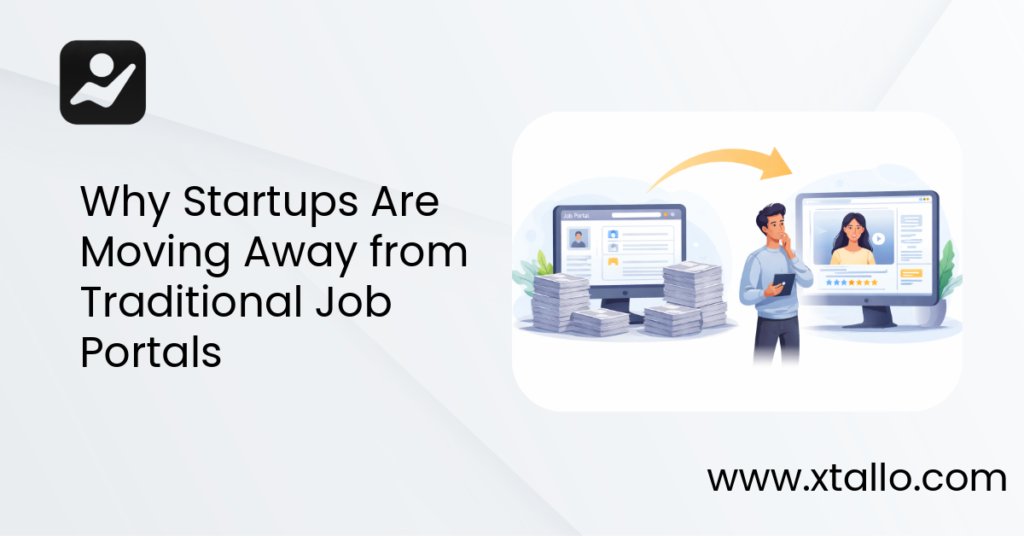
The way companies hire talent is changing rapidly. Startups, especially those operating in fast-moving industries like SaaS, AI, fintech, and digital services, are beginning to question the value of traditional job portals.
For more than two decades, job boards and resume databases dominated hiring. Platforms allowed companies to post jobs, receive hundreds of applications, and shortlist candidates based on resumes. But the hiring environment of 2026 and beyond looks very different.
Startups now prioritize speed, proof of skills, culture fit, and efficiency – areas where traditional job portals often fall short.
This shift is pushing companies toward modern hiring systems such as video-first profiles, portfolio-driven evaluation, and direct talent marketplaces.
Below is a complete breakdown of why startups are gradually moving away from traditional job portals and what alternatives are replacing them.
1. Traditional Job Portals vs Modern Hiring Needs
The biggest problem with conventional job boards is that they were designed for a hiring environment that existed 15–20 years ago. Startups today operate with different priorities.
| Hiring Factor | Traditional Job Portals | Modern Startup Hiring |
|---|---|---|
| Speed of Hiring | Slow screening process with hundreds of resumes | Fast evaluation using video introductions and portfolios |
| Candidate Evaluation | Based mainly on written resumes | Based on skills, proof of work, and communication |
| Quality of Applications | Large number of irrelevant applications | Smaller pool but highly relevant candidates |
| Hiring Cycle | Often takes weeks or months | Can be completed in days |
| Talent Visibility | Limited understanding of personality and communication | Full profile including video, work samples, and projects |
Startups operate in environments where delayed hiring can slow down product launches, sales expansion, and growth strategies.
Because of this, founders and hiring managers want systems that help them identify the right candidate quickly instead of filtering hundreds of resumes.
2. The Resume Problem
Traditional hiring relies heavily on resumes. But resumes present several limitations.
| Resume Limitation | Impact on Companies | Impact on Candidates |
|---|---|---|
| Static Information | Does not show real skills or personality | Candidates cannot fully express their strengths |
| Easy to Copy or Exaggerate | Companies struggle to verify authenticity | Honest candidates compete with inflated resumes |
| No Communication Insight | Hiring teams cannot evaluate confidence or clarity | Talented communicators remain unnoticed |
| No Context of Work | Difficult to understand real project contribution | Candidates struggle to showcase impact |
This is one of the biggest reasons startups are exploring video profiles, project portfolios, and skill demonstrations instead of relying solely on resumes.
3. Application Overload
One of the biggest frustrations startups face with traditional job portals is application overload.
| Hiring Challenge | Traditional Portal Outcome | Startup Reality |
|---|---|---|
| Job Post Visibility | Jobs receive hundreds or thousands of applications | Most applications are irrelevant |
| Resume Screening | HR teams spend hours filtering candidates | Valuable hiring time is wasted |
| Candidate Quality | Many applicants apply without reading the job description | Companies struggle to identify serious professionals |
| Interview Scheduling | Too many candidates require evaluation | Hiring teams become overwhelmed |
For early-stage startups with small teams and limited HR resources, reviewing hundreds of resumes becomes inefficient.
4. Lack of Skill Verification
Startups are performance-driven environments. They need people who can deliver outcomes quickly.
Traditional job portals rarely verify real capabilities.
| Skill Assessment Factor | Traditional Job Portals | Modern Hiring Systems |
|---|---|---|
| Work Portfolio | Usually missing | Mandatory project showcase |
| Video Introduction | Not available | Standard feature |
| Case Study Presentation | Rarely included | Often encouraged |
| Real Performance Proof | Difficult to verify | Demonstrated through projects |
This is why many startups now prefer candidates who can show real work examples instead of only written experience.
5. Hiring Speed Matters for Startups
Startups move faster than large corporations. Hiring delays can affect revenue growth and operational expansion.
| Hiring Stage | Traditional Hiring Timeline | Modern Startup Hiring |
|---|---|---|
| Job Posting | Day 1 | Day 1 |
| Resume Collection | 1–2 weeks | Instant candidate discovery |
| Resume Screening | 3–5 days | Minutes using profile filters |
| Interview Scheduling | 1 week | Same day or next day |
| Hiring Decision | 1–2 weeks | Within days |
Because of this, startups increasingly prefer platforms that allow them to see candidates immediately rather than wait for applications.
6. Cultural Fit Is Hard to Evaluate
Startups rely heavily on team dynamics and communication. Unfortunately, resumes provide very little insight into personality.
| Cultural Evaluation | Traditional Job Portals | Modern Talent Platforms |
|---|---|---|
| Communication Style | Unknown until interview | Visible through video profiles |
| Confidence Level | Not visible | Immediately observable |
| Personality | Not reflected in resume | Demonstrated in introduction videos |
| Team Fit | Hard to predict | Easier to assess early |
This is why video-first hiring models are becoming popular among startups.
They allow companies to evaluate candidates before scheduling interviews.
7. Cost Efficiency for Startups
Startups operate with limited budgets. Spending large amounts on job postings without guaranteed results becomes difficult to justify.
| Cost Factor | Traditional Job Portals | Modern Hiring Platforms |
|---|---|---|
| Job Posting Fees | High recurring costs | Often performance-based models |
| Candidate Quality | Uncertain | Filtered and curated talent pools |
| Hiring Efficiency | Low | High |
| ROI | Difficult to measure | Easier to evaluate |
For founders trying to scale efficiently, better hiring ROI becomes a priority.
8. The Rise of Video-First Hiring
Video-based professional profiles are becoming increasingly popular because they provide immediate insight into candidates.
| Feature | Resume-Based Hiring | Video-First Hiring |
|---|---|---|
| Candidate Introduction | Written summary | Personal video introduction |
| Communication Assessment | Not possible | Immediate |
| Professional Confidence | Hard to judge | Clearly visible |
| Employer Trust | Limited | Stronger |
Startups increasingly want to see the person behind the resume before scheduling interviews.
9. Talent Discovery vs Job Applications
Traditional job portals rely on applications. Modern hiring systems emphasize talent discovery.
| Hiring Model | Traditional Portal | Modern Hiring Platform |
|---|---|---|
| Talent Discovery | Companies wait for applications | Companies search and discover talent |
| Candidate Visibility | Limited to job applications | Public professional profiles |
| Hiring Approach | Reactive | Proactive |
| Candidate Branding | Minimal | Strong personal brand |
This model allows companies to identify high-potential professionals even if they did not apply for a job.
10. The Future of Startup Hiring
The future of hiring will likely focus on proof, personality, and performance rather than resumes alone.
Startups are increasingly adopting systems that include:
| Future Hiring Element | Description |
|---|---|
| Video Profiles | Candidates introduce themselves and explain their expertise |
| Project-Based Portfolios | Professionals showcase real work |
| Skill Demonstrations | Candidates present case studies or solutions |
| Tiered Talent Pools | Top performers categorized by performance and reviews |
| Faster Hiring Decisions | Companies evaluate candidates instantly |
These changes represent a broader transformation in how companies discover and evaluate talent.
Conclusion
The hiring landscape is evolving quickly. While traditional job portals still play a role in recruitment, startups are gradually exploring more efficient and transparent hiring models.
The shift is driven by the need for:
- Faster hiring decisions
- Better talent visibility
- Verified skills and portfolios
- Improved cultural fit assessment
Modern hiring platforms that combine video introductions, professional portfolios, and structured talent discovery are beginning to redefine how companies evaluate professionals.
For startups aiming to grow rapidly, the future of hiring will likely move toward evidence-based professional profiles rather than static resumes.