
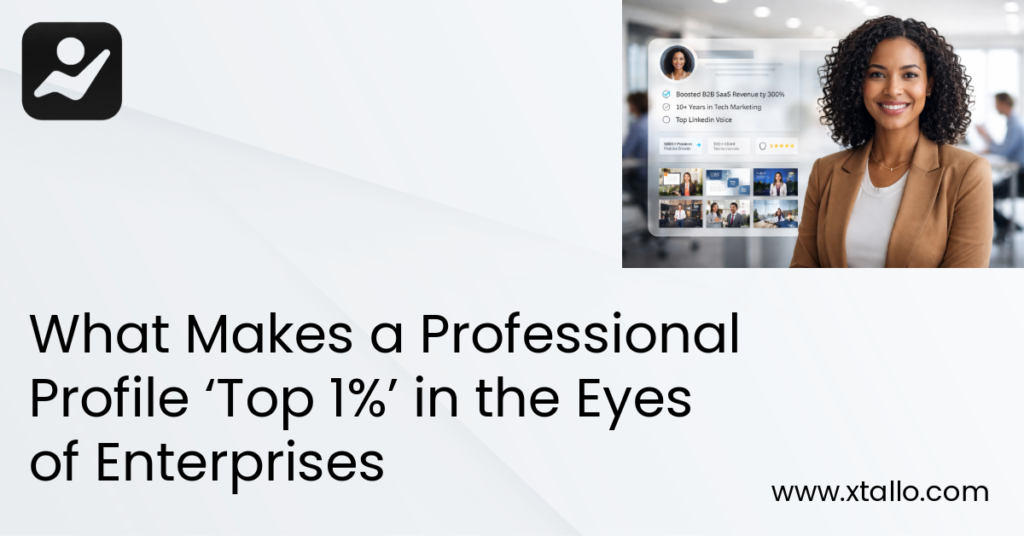
In today’s hiring landscape, enterprises are no longer impressed by generic resumes, long job descriptions, or fancy titles. Companies want proof of impact. They want professionals who demonstrate clear results, strategic thinking, and credibility.
The difference between an average profile and a Top 1% professional profile is not years of experience — it’s clarity of value, proof of performance, and positioning.
Enterprises reviewing candidates for senior roles, consulting projects, or strategic hires usually evaluate profiles through a very different lens. Instead of focusing only on qualifications, they analyze business outcomes, leadership signals, and real-world credibility.
A Top 1% profile communicates one powerful message within seconds:
“This person can create measurable value for our organization.”
Below is a breakdown of the core elements enterprises look for when identifying top-tier professional profiles.
Key Elements That Define a Top 1% Professional Profile
| Profile Element | What Most Professionals Do | What Top 1% Professionals Do | Why Enterprises Care |
|---|---|---|---|
| Professional Headline | Lists job title only (e.g., “Marketing Manager”) | Clearly states expertise and impact (e.g., “Scaling SaaS Revenue Through Demand Generation & Enterprise Partnerships”) | Shows strategic thinking and positioning |
| Value Proposition | Describes responsibilities | Explains the problem they solve and the value they bring | Enterprises hire problem-solvers, not job titles |
| Proof of Results | Mentions tasks performed | Shows metrics, growth numbers, or measurable outcomes | Demonstrates real business impact |
| Portfolio / Work Samples | Rarely included | Provides case studies, projects, or product contributions | Helps employers quickly evaluate capability |
| Industry Positioning | Generic experience description | Clearly positions expertise in a specific industry or niche | Enterprises prefer specialists over generalists |
| Credibility Signals | Basic profile with limited validation | Includes client reviews, leadership experience, and recognized achievements | Builds trust instantly |
| Communication Style | Passive language | Confident, concise, and impact-focused language | Signals leadership potential |
| Professional Branding | Inconsistent or minimal personal brand | Strong personal narrative and consistent positioning | Helps companies understand the professional’s direction |
| Thought Leadership | No insights shared publicly | Shares industry insights, ideas, or frameworks | Indicates strategic thinking |
| Video or Personal Introduction | Not present | Short video introduction explaining expertise and impact | Creates instant trust and personality connection |
How Enterprises Actually Evaluate Professional Profiles
Large organizations rarely review profiles the same way smaller companies do. Instead of scanning qualifications, enterprise hiring teams often ask questions like:
- Does this professional demonstrate clear business impact?
- Can they solve high-level problems in our organization?
- Do they show leadership or strategic thinking?
- Is there evidence of real-world results?
Professionals who answer these questions clearly through their profile automatically stand out.
Common Mistakes That Prevent Professionals from Reaching Top 1%
Even talented professionals often fail to position themselves correctly. The most common mistakes include:
| Mistake | Why It Hurts the Profile |
|---|---|
| Listing responsibilities instead of achievements | Employers cannot see the real value created |
| Writing long, unclear summaries | Decision makers prefer quick clarity |
| No proof of work or case studies | Reduces credibility |
| Weak professional headline | Fails to capture attention |
| Lack of specialization | Makes the candidate appear replaceable |
The Future of Professional Profiles
Traditional resumes are gradually losing relevance. Enterprises increasingly prefer professionals who can demonstrate their value through:
- Video introductions
- Real project portfolios
- Verified work experience
- Client feedback and reviews
A professional profile that combines clear positioning, proven outcomes, and credibility signals becomes far more powerful than a static resume.
This shift is why many modern hiring platforms are moving toward video-first and proof-based professional profiles, where companies can understand a candidate’s expertise before even scheduling an interview.
Conclusion
The difference between an average professional profile and a Top 1% enterprise-ready profile lies in how clearly it communicates value, credibility, and results.
Professionals who focus on impact instead of responsibilities, specialization instead of generic experience, and proof instead of claims naturally stand out to enterprise hiring teams.
As hiring continues to evolve, professionals who present themselves through modern, transparent, and results-driven profiles will gain a significant advantage in the global talent marketplace.
Platforms like Xtallo are emerging to support this shift – helping professionals showcase their expertise through video introductions, verified achievements, and modern professional profiles, making it easier for enterprises to identify truly exceptional talent.